I was 10, and my mother gifted me her tarot deck, the one that I had coveted for many years before. When I was 11 my father—in response to my fascination with witches and witchcraft, hoped he could form a broader atheist critique of Christian doctrine in his child so, he offered me a copy of Betrand Russel’s Why I Am Not a Christian. When I was 14, I struggled to make sense of a copy of Capital Volume 1, that was given to me an older cousin who after several conversations became annoyed with my unstudied and unnamed anti-capitalism. And when I was 15, I discovered Emma Goldman’s Anarchism and Other Essays in a used bookshop. For the particularities that formed my teenage brain at the time, Goldman’s brash anti-authoritarian writing offered a thread between these various touch-stones: NO GODS, NO MASTERS.
I am mildly embarrassed to admit that the first gift—Tarot—has for the majority of my life, lurked behind the scenes in my thinking, and many life choices. Strangely enough, it has often been these cards, that have held me accountable to doing the inner work of undoing narratives that fuel resent and apathy. These cards remind me again and again that, both ‘gods’ and ‘masters’ are powerful concepts, who’s defeat is always also the demand to defeat the concept of gods and masters. What draws me to Tarot, is not unlike what lured portions of the New Left of the 1960’&70s into the ‘New Age’ of the 70’s &80’s—the lure is this a-prior question: How can we abolish the police, if we haven’t also disarmed the ‘little cop’ that lives within our thinking? Philosophy and critical theory are wasted ideas if we cannot direct our inquiry and analysis towards the transformation of both our outer and inner worlds. It is in this sense that Tarot has been an ideal companion reader to the many other books and essays that fill my shelves, and inform these pages.
I am writing this introduction throughout the summer of 2023, and I have now been working on this tarot deck for almost 7 years. When I started working on this tarot deck, I originally planned on calling it MARX-WITCH. This was the title of a (not-very good) short-comic I made about a fictional witch devoted to the idea using her magic towards realizing a marxist-revolutionary program. At the time, that little comic wasn’t really worth pursuing, but the illustrations of an alternate tarot cards caught my interest.
What would a ‘MARX-WITCH’ tarot deck look like? Who would inhabit the pantheon of a ‘left’ Major Arcana? Seven years later, I am writing this text, trying to better understand my motive for making this object. And continuing to make it: through multiple jobs, through multiple ‘potentially revolutionary moments’, through ever-increasing climate-catastrophes, through a global pandemic of which we saw de-facto mass strikes and work-slow downs, through radically changing technological and labour conditions. Through these many changing conditions, I found myself more and more drawn to working on this deck. The research helped me situate a spectrum of emotions and experiences against an expansive backdrop of historical figures and scenarios. For instance, after a traumatic birthing experience in 2020, I was surprised and heartened tofind unlikely insights on postpartum depression from Ulrike Meinhoff, of the german Red Army Faction.
My approach to making this tarot deck, has been to weave the tradition of tarot with the rich history of protest & counter-culture, critical theory, and broadly speaking—‘the Left’—in order to try to better make sense of our current moment in history and in life.
The Left, of course, is a contentious category. Some see the notion of ‘the left’ as a rather hollow term, or imposing a false or compromising unity, clumping together everything from marxists, to reformist-liberals, and insurgent anarchists—invoking some kind of unholy alliance. However, my intention with the name was a specific nod towards the various instantiations of the ‘New Left’ that are featured throughout this deck: from the debates that have occurred within the pages of the British scholarly journal, “the New Left Review’, and then more importantly a nod to the many revolutionary “new-left’ people’s movements that happened across the globe during the 1960’s,70’s, and onward. Over the course of writing the entries for this book, unsurprisingly what became clear is that this arcana is—as much as anything else—a pantheon of my enduring personal interests, curiosities and intellectual commitments, as someone who for most of their life has felt a strong affinity to the grand-social project often referred to as ‘ the New Left’, and the many ways in which it appears and re-appears anew through time.
The awkwardness and seeming contradiction of bringing together the categories of New-Left and Tarot, is not lost upon me. I have no doubt that inclusion in a Tarot Major Arcana, would have some of the figures within this deck ‘rolling over in their graves’. Famously, Theodor Adorno railed against occultism as Fascist form, and dedicated an entire study to prove the authoritarian impulses that is proliferated through the culture American Astrology the 1950s. In The Stars Down to Earth, Adorno performs a close ideological analysis and case-study of the Los Angeles Times Astrology column from nov 1952- Feb 1953. However, it is my person opinion that a retrospective reading this text from a broader historical and political vantage point, one sees a series of Judeo-Christian/monotheistic biases, and moreover, we see that what Adorno fails to name is the broader violence of which this newspaper is an expression of. He is eluded by the full nature of what the Los Angeles Times as a publication is. It is an ideological mouth-piece for a state in which (at the time) Hollywood was engaged in a crazed campaign against communists, a state where the governor of California successfully advocated for the internment of Japanese Americans, a state where Ronald Regan began his political career. Which is simply to say, the trouble with Adorno’s case study of Astrology is an a-priori problem: the California of 1950’s was not in danger of being turned fascist by astrology—because it already was fascist.
This is, of course, not to say that astrology and (more importantly for our purposes) Tarot are without their own colonial, fascist, and white-supremacist entanglements, or that Adorno’s critique is without merit. Rather, what I am implying is that the attraction to practices like astrology or in our case Tarot, emerge from minor histories that are infinitely more complicated, gendered and racialized, in ways that Stars Down to Earth, as a text is unwilling to grapple with.
Tarot often meets both its readers and its querent at intersections of deep uncertainty and desire to believe in something. As noted by Karen Gregory, digital sociologist and ethnographer, “Historically, tarot card reading and fortune-telling has been associated with women’s work and a form of “pick-up” or temporary work that women would engage in to supplement a family or their own income.” Because these divinatory traditions speak in jargonistic and coded tongues, these insights can take on a range of political characteristics and valances. Many of which lie in the varied claims towards some sort of authentic meaning for the tradition of tarot.
A STREAM WITH STRANGE MOMENTUM:
78 CARDS AND PSEUDO-HISTORY AS A PRACTICE
Tarot cards as a practice of ‘reading a spread’ from this set of 78 cards composed of the usual Major and Minor Arcana—this practice holds variety of strange origin stories, and pseudo histories. In the process of researching the historical background of tarot, (one which I had previously been relatively uncurious about), I initially came across the many fantastical versions of it’s history… apparently it was the invention of ancient Egyptian hermetic traditions, or others say it emerges from the divinatory practices of medieval witches, or that it goes back to fortune-telling traditions the Roma people, or alternately that it goes back to the Tora and the tree of life, some even arguing it as a wisdom passed on to us by extraterrestrials. The contemporary Tarot community has some particularly strange corners (a point we will return to later).
Setting aside community folklores, the consensus among historians appears to show that it was initially a Renaissance parlor game, it’s creation, a set of cards by artist Michelelino da Besozzo, alluding to the social, political, existential, and family rivals of the Duke Filippo Maria Visconti, within a larger deck of playing cards– intended for the entertainment of this aristocratic family.
The cards don’t make their first divinatory appearance until eighteenth-century France, an era marked by a colonialist fetish for projecting personal meaning onto that which they don’t understand—these cards take on mystical attributes primarily because the people that come into contact with them don’t quite know what they are. Scholar, Helen Farely describes the transition in this way:
In eighteenth-century France, tarot underwent its first major transformation, evolving into an esoteric device of divination. With tarot removed from its original environment, its symbolism lost its previous relevance and context, rendering its imagery mysterious. Hence, tarot’s shift in function coincided with an altered view of the content of its symbolism, believed to be an expression of esoteric lore. Antoine Court de Gébelin reinterpreted the deck as the lost Book of Thoth. It’s symbolism, he espoused, concealed the secrets of an ancient and wise Egyptian priesthood, forced to conceal their most precious secrets in a game to ensure their survival.
And so, people like Antoine Court de Gébelin set into motion the legacy of fantasy and speculative fabulation around the origin of these cards. From there, the deck travels across the channel to England and is adopted and re-interpreted by members of the Golden Dawn and the London Theosophical Society. Figures like, Aleister Crowley, William Butler Yeats, and Arthur Edward Waite (of the well-known ‘Rider-Waite’ Tarot Deck) re-examine and re-write the systems of knowledge offered within these illustrations. And it is with Arthur Edward Waite’s re-interpretation of the deck, and Pamela Colman Smith’s iconic illustration of the minor arcana cards, that the standard for Modern Tarot is established. The Rider-Waite Tarot has become the interpretive system of record for most contemporary Tarot decks (including this one).
The cultural environment that swirled around the popular re-emergence of the tarot was a hot-mess of ritual magic, Free Masonary, Christian mysticism, intellectual encounters between east and west, radical propositions for colonial independence and emancipation, and women’s suffrage movements. However, this moment of new spiritual societies (mostly circulating around Freemasonry, and Rosicrucianism) is also marked by an attraction to proto-fascist cosmologies of radicalized hierarchies, and for some the encounter with alternate and mysterious metaphysical wisdoms leads down a path of psychosis and unhinged nihilism. One cannot ignore this history and the way in which historically and in the present the occult, and tarot has been a tool popular among emancipatory imaginaries but also fascists, traditionalists, and right-wing nihilists.
This is an important problem that we will return to later.
THE NEW AGE, THE NEW LEFT, AND THE STRUGGLE TOWARDS NEW EARTH(S):
The new ‘New Age’ movement, of the 1970 situated Tarot as useful way re-introduce metaphysical issues and experiment the possibilities of these early haptic technologies. Much of the Counter-Culture of this era took interest in esoteric tools of many different cultures and backgrounds: whether it was throwing the I Ching; or a set of charms; reading a palm or; Oomancy (a term for divination via the use of an egg in a water bowl); or telling a fortune by way of tea leaves, the list could go on. Regardless of the method, this New Age of the 1960-80s, was, not unlike the New Age esoterics of the early 1900s in which the Rider-Waite Tarot Deck originates, or for that matter the Italian Renaissance of mid 1400s in which the earlyTarocchi emerges—each era is marked by a culture of curiosity and fetish towards the notion of a wisdom concealed just beyond the horizons of established thought. And while the use of these esoteric tools may have wild romanticisms, cultural-appropriations & misunderstanding cooked into their legacy—anyone who has found a place in their lives for Tarot, knows—tarot and many forms of divination all too often—because of the way they surrender to randomness—tends to stumble into revelatory sets of self-reflections and understanding more often than not.
how can we come to better understand that which continues to allude us?’
physics and the drive to understand that which is just outside of knowability
To observe this moment of the late 1970-1980s in which tarot re-emerges, its difficult not to be struck by the extent to which, reading the visual, becomes a discreet approach and popular focal point. It is at this time that intellectual wings of American Advertising culture begin to expand their territory (more explicitly) into the depths of popular consciousness.
It is also during this time that certain corners of Marxism, Communications Studies and Art History, these freshly minted disciplines become fixated on the possibility of finding new levels of understanding through careful study of the images the world was presenting us with.
This historical moment finds itself dominantly preoccupied with an impulse to look towards semi-random images offered by chance or intention, in an attempt to use images to better know the world. At this time, for many groups—within and adjacent to the New Age movements of the seventies—tarot becomes and popular tool to navigate this encounter with what alludes us.
Tarot is an integral part of this worldview, it’s symbolism confidently projecting each of these apparently divergent streams, to emerge as the New Age tool par excellence. Previously, occultists searched for the one true tarot; they ‘rectified’ or ‘corrected’ the deck in accordance with their beliefs. They judged that tarot had been deliberately altered to conceal its true purpose and meaning, or it had been carelessly copied resulting in an inadvertent loss of significance. With the advent of the New Age, tarot designers felt able to ‘re-imagine’ the deck, no longer afraid to experiment, comfortable with creating links to other cultures or to create decks that fulfilled roles other than divination.
Tarot, takes on the role of beautiful intuition machine passed down from some kind of imagined ancient tradition. And while it can be argued that Tarot became celebrated by the same parts of the 1960’s counter-culture that historian Fred Turner, shows as having turned its back on the politics of ‘the New Left’, more attention to the subject shows that this is not the entire narrative. Conversely David Kubrin notes in his Introduction to Marxism and WitchCraft, that New Age spirituality and neo-paganism, are deeply entangled with the environmental and anti-nuclear activism movements of the 1980s. Tarot has long figured in the backgrounds of many generations of feminists, and has become wildly popular among women of color, queer communities and many other marginalized groups who weave their own personal experiences and culture into the discourse of Tarot and ‘reading’ from a deck of cards.
When one looks just outside the secularist lens, (which is so common within the Left), one sees long traditions of mysticisms: from the overlapping social world of Free-Masonary and the early International Workingman’s Association (IWA); or the role that herbalism and folk magic have historically played a role within the pre-capitalist Commons; the tradition of mysticism is woven through the Russian Revolution with a long tradition of ‘mystical anarchism’ in Russia; and even within Socialist Sandinistas of Nicaragua, their namesake icon Augusto César Sandino (1895- 1934) was “enthralled by the Magnetic Spiritual School, theosophy, and Zoroastrian, Hindu, and cabalist lore, fusing all these ideas with communist ones ins such a way that he was refused entry to the Third International…”. And yet again this tradition pops up in the french socialist intelligentsia of 1930s, which saw George Bataille’s secret society Acephale emerge out of the failed ashes of attempts to form a coalition between Contre-Attaque, Andre Bretton and other elements French Socialist Left to resist the rising tide of Fascism in France at the time.
This is in essence what the German Marxist Ernst Bloch (1885 – 1977) refers to as “warm-streams” of Marxism: the ‘heaven on earth’, the egalitarian drives within socialism, and other seductive offering of a better future. Warm stream, he describes as being generally related to: cultural and artistic expressions, creativity, desiring, myth and mysticism, religion, and ‘feelingness’. This is posed against a categorical cold-stream, which is associated with science, reason, law, order, and ‘knowingness’. One can glean some of the obviously neglected importance of this warm-stream, in our collective work towards revolution. Bloch insinuates the two streams as a difficult pairing at a dinner-table,
“The whole surplus force of culture finds its salvation there, and these forces are becoming more and more relevant to us all the time—above all the wealth of artistic allegories and religious symbols, whose day is not yet done when the ideology which bore them disappears. An old sage once said man is easier to save than to feed. The coming age of Socialism will find, when everyone has sat down to the meal, that the conventional reversal of this paradox is very indigestible indeed: that man is easier to feed than to save.“
Who we invite to this imagined dinner-table of the revolution, matters immensely: these invitations and invocation determine qualities and characteristics of the past and present, which we hope to bring with us into the future. While not an exhaustive list, this tarot deck features the many figures, ideas, and lessons, I would hope to see present at such a dinner-party. The guest and ingredients have been compiled with a special attention to the challenging bond between Anarchism and Marxism, and the international occurrence of spontaneous and organized resistance and transformation. With that said, many will likely have comment and criticism for who was invited and who was not, “why Lucy Parsons, and not …(insert other anarchist thinker here). What I will say to this is: this Arcana is a representation of this ideas and thinkers that has guided me through some of the discomfort of this paradox and the bottomless glass of crises that has defined the last decade— it has helped sober my thoughts through the tipsy nihilism and nostalgia that can creep in during the late hours. And so this is my defense of a new-left spiritualism and all forms of agit-prop in service of imbricating a new world into the old.
THE PROBLEM OF A NEW AGE HORSESHOE THEORY:
It is at the point, which we find ourselves most ready to sit down at the table of cards and a liberated sense of the value of left world-building, that we must back-track and address the unwanted dish: a hefty serving of horseshoe theory. In a nut-shell Horseshoe theory posits the far-left and the far-right rather than being opposing ends of a linear continuum on a political spectrum, instead are alike similar to opposite ends of a horseshoe. This is a particularly unpopular idea among many of anarchist and marxists, for many reasons. Among these reasons: firstly, this theory is used mostly for the purposes of red-baiting, conflating anti-fascists with white-supremacists, and smoothing over an insidious means of discrediting the social demands put forward by the Left. The second reason being that it’s generally untrue. A study conducted in 2012 showed:
“The present results thus do not corroborate the idea that adherents to extreme ideologies on the left-wing and right-wing sides resemble each other but instead support the alternative perspective that different extreme ideologies attract different people.”
A 2019 study similarly concluded, ”our findings suggest that speaking of ‘extreme left-wing values’ or ‘extreme right-wing values’ may not be meaningful, as members of both groups are heterogeneous in the values that they endorse.” What is obscured, within this mostly useless horseshoe metaphor, is the hand-in glove proximity of the center with its imagined political adversary. Furthermore, as Leon Trotsky points out in 1938 “Their Morals and Ours”,
“The fundamental feature of [arguments comparing disparate political movements] lies in their completely ignoring the material foundation of the various currents, that is, their class nature and by that token their objective historical role. Instead they evaluate and classify different currents according to some external and secondary manifestation … Hitler, liberalism and Marxism are twins because they ignore ‘blood and honor’. To a democrat, fascism and Bolshevism are twins because they do not bow before universal suffrage … Different classes in the name of different aims may in certain instances utilize similar means. Essentially it cannot be otherwise.”
And so, why even bring up such a widely discredited social theory? The answer to that is, sadly we are at a particular juncture in political history, in which it is hard to ignore the concerted effort (particularly from the Right) to obscure the obvious and fundamental differences between fascists and anti-fascists. Furthermore, tarot and some online tarot-readers have become swept up in what is popularly referred to as a ‘new-age’ to ‘alt-right’ pipe-line. This is a moment in which unfortunately it has become lucrative cultural-grift to promote an uncritical blurring of left and right under the guise of “free-thinking” and recruit ideas and individuals from the left towards more conservative and reactionary political visions.
This left-right drift is brilliantly described by Naomi Klein in her recent book Doppelgänger. In which, she discusses the extent to which the left (center left liberals as well as dedicated ‘far-lefties’) have been consistently ceding ideological territory for fear of landing on common territory with outlandish conspiracy theorists and ‘wellness’ quacks:
“Once an issue is touched by “them”, it seems to become oddly untouchable by almost everyone else. And what mainstream liberals ignore and neglect, this emerging alliance lavishes with attention.”
She continues on to propose a useful alternative to the horseshoe-theory, which she describes as a diagonal crossing through and from left to right.This diagonal crossing opens the space to consider the locations which sway and recruit the impulses of a mass anxiety and rage towards the current state of the world. Klein’s mirror-world is the world of alt-right pipelines—yoga,’crunchy, self-help, astrology, tarot, and even marxism—all roads lead the the alt-right pipeline. to alt-right implies the same left-to right pull towards an .
In the world of contemporary Marxism, Anarchism, and Cultural Theory one finds just on other side of this diagonal split, we find: Accelerationism, ‘the Dark Enlightenment’, ‘anarcho-captitalists’ and then of course the strange moment of Dime Square kids (aka the Peter Thiel’s morbid attempt to create a hip fascist youth-culture in New York City). And while, horseshoe theory may be mostly useless as a concept, attention to the problem of the slippage between anarchists and libertarians, between class-first socialists and nationalists demand our attention and can point us towards the aftermath of similar historical moments of emergent Fascisms and anti-fascisms in the past. For instance, European DaDaist (1915-1920) and Surrealist (1920-1950s), these movements were hubs for socialists, nihilists, anti-fascists, and fascists alike. And so to return to our horseshoe: while we may not share common ideological grounds, (for better and worse) we may at times be sharing points of reference with our enemies, whether that be Accelerationism, the occult, Hegemony, Emma Goldman, or Tarot Cards. It is for these reasons that it is so necessary to parse the political nuances of the ways in which, these ideas, thinkers, and tools are deployed. While equivocating the opposite points in the imagined ‘horse-shoe’ of a radical right and a radical left in generally disingenuous and inaccurate—this is a time where more than ever we must contend with both bad-faith actors (don’t forget the extent to which the state intentionally attempts to disrupt and manipulate the consensus around what certain terms mean.
While occultism/spirituality may be a ripe landscape for diagonal drifts, it would be a loss to structurally disavow mysticism, or spiritualism, at this juncture in time when the changing conditions, have so many grasping for new tools of making meaning out of the world. The experience of conditions and categories constantly changing, is precisely where meaning making machines like tarot, are useful.
One of the lessons we can glean from these aforementioned cultural avant-gardes is that those who seek to change the world (regardless of the ideological character of their particular world-view, tend to be drawn to ideas, aesthetics and practices that allow us to see the world anew, and/or a skewed.
Tarot happens to be just this type of tool, “Tarot’s very utility lies in this reflexive ability, making it an invaluable tool for deconstructing our narratives, questioning our social codes, consciously directing our lives , and improving this world we live in.” Grappling with internal and external contradictions, is where we see the Tarot cards shine, the cards have nimble ability to produce shared understanding. Ultimately this “New Left Tarot” has been an exploration of ‘how can a card (or idea) meant to be about a people’s revolution, equally hold the possibility of a reactionary or authoritarian impulses when seen in a reverse position? What might we learn about our selves and our politics when we delve deeper into the relationship between the liberation and the domination. It is an experimenting towards an informed utopian socialism. How do we think we are going bring about some new anti-capitalist world, if we haven’t worked upon our own internalized capitalist, colonialist, and or hierarchical narratives about growth, progress, success, poverty, family, reproduction, and who and what is perceived as having ‘value’? This is the kind of integrated approaches that I hope these cards can bring about for some of those who use them.
INTRODUCTION TO THE DIALECTICAL SPIRAL TAROT SPREAD.
Within the Tarot there are many different ‘spreads’—a term used to describe the pattern or schema of cards and their assigned meaning. Many practicing tarot will likely know a handful of popular schemas like the ‘celtic-cross’, or “mind-body-spirit” spread, or a simple one-card call for guidance. And many develop their own particular schematics or variations. For this reason, it was hard to resist the possibility of developing a ‘spread’ particular to the New Left Tarot. Imagining this prospect instantly brought me to Stanley Aronowitz’s elucidation of dialectical materialism and describing ‘the dialectic as a spiral’. From this premise, a few spreads were developed, which built upon different visual diagrams illustrating the concept of the dialectic. The Dialectical Spread opens a space for reflection upon the constant yet ever-changing tensions between opposing states of being. It is my hope that this spread can be used to reflect not only on the querent’s private dilemmas, but also for possible insights to
the broader political challenges that confronts our lived experience on a daily basis.
HOW TO USE THE DIALECTIC SPIRAL.

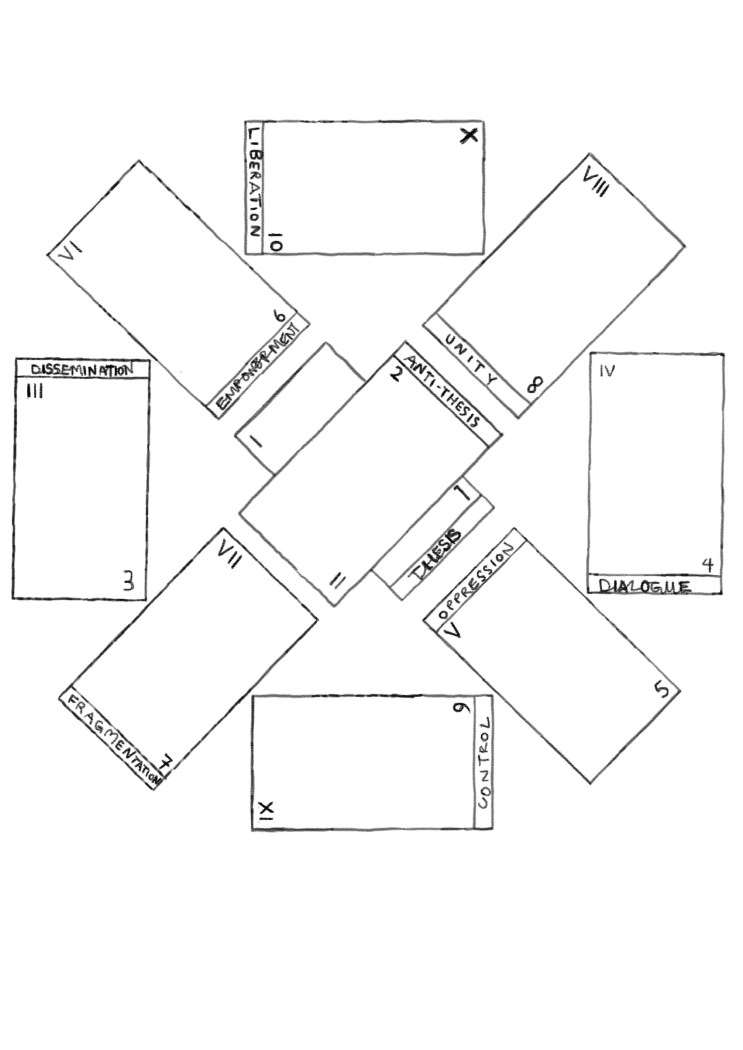
-Shuffle cards until ready. Pull cards in the following order according to the pattern seen in fig.01.
-Name the cards according to the numbered categories (say each name aloud or in your head)
- THESIS: the card showing the animating force of the querent’s question
- ANTI-THESIS: the card showing the aspects blocking the querent’s desire
- DISSEMINATION: the card showing what the querent already knows about the situation
- DIALOGUE: the card showing what still needs to be understood or communicated.
OPPRESSION: the card showing external aspects
- EMPOWERMENT: the card showing aspects that can empower querent
7. FRAGMENTATION: the card showing locations of confusion and misunderstanding.
8. UNITY: the card showing the aspects directing the querent towards integration.
9. CONTROL: the card showing the means of control for the querent in this situation
10. LIBERATION: the card showing what is possible outcome when the querent problem or question is resolved or released.
fig#01
 monthlysmokeandmirrors.com