IN SHORT:
UPRIGHT: Planning for the future. Decisions & discoveries. Utopian explorations. Enjoyment of persistent progress.
REVERSED: Long-term personal goals. Strong connection with personal vision, style and desire. Lack of connection with the outside world. Reticence towards the unknown/that which cannot be planned for. Egoism and slippery political allegiances.
KEEP SCROLLING DOWN FOR IN DEPTH EXPLANATION
“I prefer drawing to talking. Drawing is faster, and leaves less room for lies.”
― Le Corbusier
IN DEPTH:
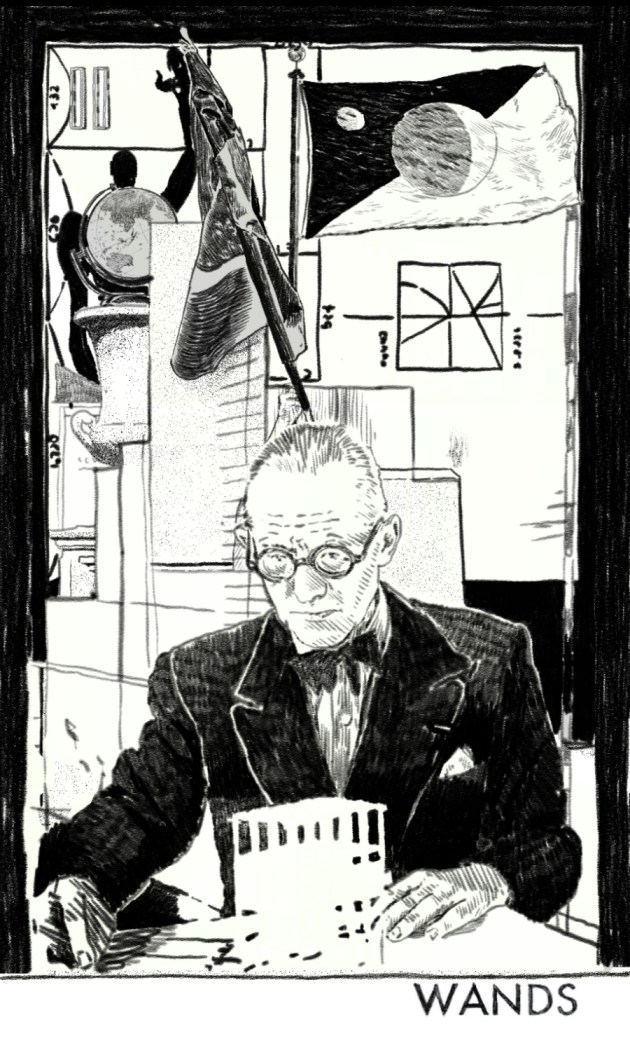
The Two of Wands shows an older man, in suit and bowtie looking over architectural model, and plans. Behind him, a globe, a poster of ‘the universal man’ , and two flags for an imagined future syndicalist federation. He as been tasked with planning a new city—a new model for living.
The future is at his fingertips. He understands the gravity of the task at hand, to create the lived environment for a people is to engage in the activity of gods. The project has immense revolutionary potential— if he can translate what he glimpses in his ‘minds-eye’. However materializing the complex harmony of his inner vision is not straightforward activity. World-making is risky business and can lead to one down slippery ideological paths. Sometimes utopian, sometimes opportunistic, occasionally authoritarian, and often a strange brew of all of the above. At his best he sees the possibility to create human harmony and cohesion through design solutions, at his worse he is blinded by his isolation and a narcissistic belief in ‘the universal’—obscuring the very real differences between humans and the nuances of their divergent needs and desires. Luckily, Two of Wands is still at the drafting table, these drawings have not yet been submitted, and there still plenty of time to trouble-shoot and seek input and counsel from relevant stake-holders.
It is a question of building which is at the root of the social unrest of today: architecture or revolution.
Le Corbusier, Towards a New Architecture 1923
“Education will always be torn between two fatalities: apostleship and egoism.”
― Le Corbusier, When the Cathedrals Were White
FURTHER READING:
From the Radiant City to Vichy: Le Corbusier’s Plans and Politics, 1928-1942
 monthlysmokeandmirrors.com