IN SHORT:
UPRIGHT: Anxiety, worry, perfectionism, depression, isolation, nightmares
REVERSED: Externalizing inner conflicts. Delusions and struggle to see a situation clearly. Secrets, and backroom social maneuvering. Releasing responsibility
KEEP SCROLLING FOR IN DEPTH EXPLANATION
IN DEPTH:
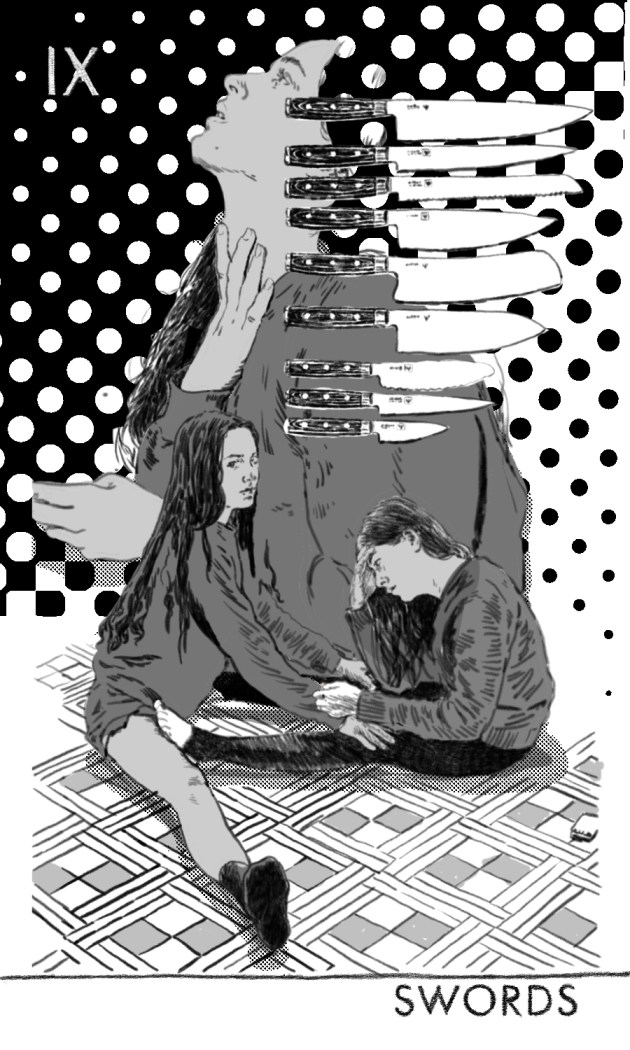
The Nine of Swords shows a dancer preparing herself for a self-made prism of anxiety, anguish and longing. She expansively stretches out atop her own shadow and floats off from the present moment to an inner dissociative place. She is cultivating inner-chamber in which she can: collect every weapon ever used against her; simmer in fearful speculations about the future; and open herself up to her own inner destroyer; she releases herself to an all consuming feeling. She lives for this, the adrenaline of living on behalf of a vision. Choices and conclusions become streamlined to move in a narrowed goal-oriented path. This is a powerful momentum that can bring great destruction but also new and refined manifestations of justice.
When the Nine of Swords presents its collection of knives in an upright position, it indicates the feeling of giving into a self-perpetuating cycle. The dancer becomes a pyramid of emotional needs and ‘inner-selves’. The Nine of Swords is a dance of internalization: in order move forward she must witness the hurt of her inner child, be a loving mother to her own suffering, and aspire to the heights of her heroes to the point that she becomes her own worst critic and most devoted teacher. However this no person is an island, and this level of perfectionism and internalization is a heavy burden and can wear down one’s composure. In the upright the nine of Swords ask us to overcome our isolation and self-limiting beliefs. The two dancers at the base of the image suggest the transformative power of human connection (consider reaching out to an old friend or comrade). The Nine of Swords invites us to fall in love with our own artistic and bodily impulses, and forgive our missteps as learn this unique dance of simply being ourselves. If you suffer from anxiety or a negative self-image that holds you back, this card suggests caring for oneself and treating yourself and others with greater compassion. Allow yourself to be loved and adored for a time. Accept yourself as the protagonist of your world. Be entertained by the grandeur of your own intrinsic value and miraculous worth. This can open our bodies up to healing and transcending generational traumas cycles and curses.
However when these dancers hang upside down we see an emotional reaction spinning out into real time. The above self-celebration and expansion slips into aspects of narcism and megalomania. A singular bad experience, as observed by our harsh inner-critic spirals out towards inner power-struggles that link a singular situation to a broader narrative of our life and grievances. This state make us more prone to martyrdom and messiah complexes. One may find themselves suddenly unleashing a series of attacks and counter-attacks—perhaps without even realizing it. This dancer must reflect on the words of her teacher, “When you dance the dance of another, you make yourself in the image of its creator. You empty yourself so that her work can live within you.” There are times that call for a hollowing out personal preferences in order to make space for a grand choreography greater than any individual dancer. However, be cautious who and what visions you offer yourself to, dancing the dance of another may get you caught in the crosshairs of a movement that is not yours.
……………………………………………………………………………………………..
“Why is everyone so ready to think the worst is over?”
Susie Bannion, Suspiria 2018
“A delusion is lies that tell truth.”
Dr. Josef Klemperer, Suspiria 2018
 monthlysmokeandmirrors.com