“Do not ask who I am and do not ask me to remain the same: leave it to our bureaucrats and our police to see that our papers are in order. At least spare us their morality when we write.”
-The Archaeology of Knowledge (1972), tr. A. M. Sheridan Smith (New York: Pantheon)
“I’m very proud that some people think that I’m a danger for the intellectual health of students. When people start thinking of health in intellectual activities, I think there is something wrong. In their opinion I am a dangerous man, since I am a crypto-Marxist, an irrationalist, a nihilist.”-Truth, Power, Self : An Interview with Michel Foucault (25 October 1982)
“My point is not that everything is bad, but that everything is dangerous, which is not exactly the same as bad. If everything is dangerous, then we always have something to do. So my position leads not to apathy but to a hyper- and pessimistic activism. I think that the ethico-political choice we have to make every day is to determine which is the main danger.“
-Michel Foucault quoted in Hubert L. Dreyfus and Paul Rabinow, ‘Michel Foucault: Beyond Structuralism and Hermeneutics’, 2nd ed. Chicago: University of Chicago Press. (1983)
KEEP SCROLLING DOWN.
IN SHORT:
UPRIGHT: Intellectual and philosophic wisdom. Pay attention to calls for protecting conformity, orthodoxy, tradition, and institutions.
REVERSED: Care of the Self. Practice journaling and observing oneself. Examine personal beliefs, freedom, social norms
AT LENGTH:
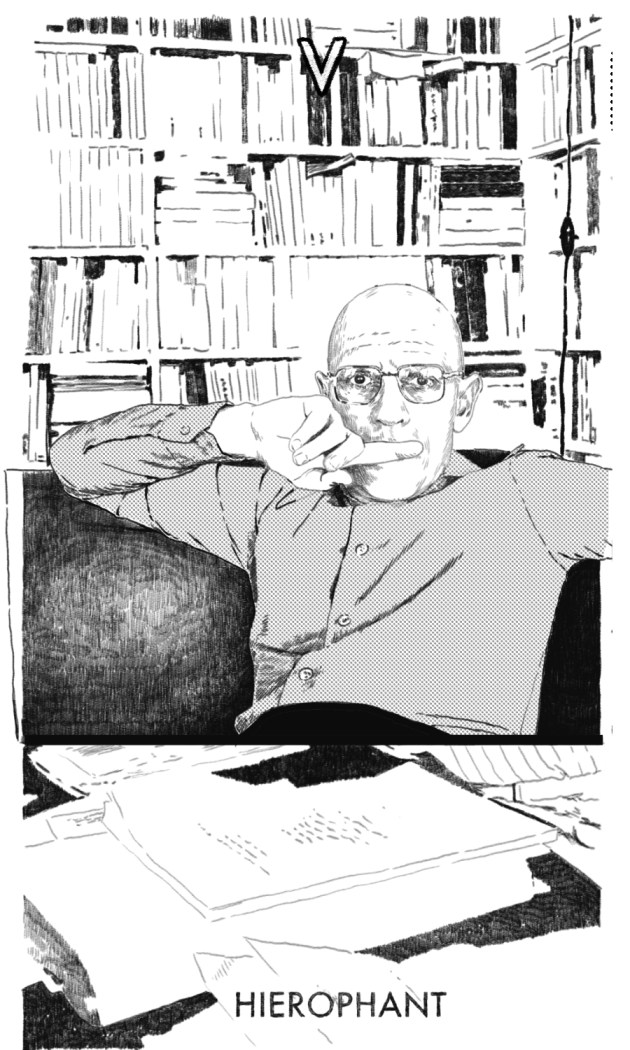
The Hierophant keeps open office hours. He leans back into his seat. He dresses in well curated garments. He receives his students here, each overflowing with questions. He places his finger in front of his mouth—he holds his tongue—he quietly points towards a relevant books regarding what the student is attempting to describe. The Hierophant is a good teacher, he is just as intellectually generous as he his vigorously critical.
He understands that philosophical work exists not just at the level of conscious quoting of canonical thinkers, but it pulls from deep subconscious impulses and curiosities. He is an intellectual maverick who holds an unlikely but massive institutional authority. Part of his authority stems from the ability to see that ‘power’ is neither good nor bad, instead simply the results of ever-present and ever-changing power relations. Despite the hierophant’s proclivity to deconstruct and expand the concepts and locations of ‘power’—he also rallies every bit of legitimacy and mystique from the ‘great-minds’ of the past. And in doing so he imbues his current position with the type of force that can open up new paths towards a different future. He asks us to pay attention to the axis of power and knowledge.
IN DEPTH:
Michel Foucault (15 Oct 1926 – 25 June 1984) was a French philosopher, historian of ideas, writer, and political activist. His philosophical work examines the relationship of power and knowledge and how this works as a type of social control through institutions. He was born to an upper-middle-class home in Poiters, France and was educated at Lycée Henri-IV, and Ecole Normale Superieure, and had the good fortune of studying under the guidance of Jean Hyppolite and Louis Althusser at the University of Paris (the Sorbonne). As a young man he was considered a ‘troubled’ youth, who was fascinated by the more dark and morose elements of history, and was submitted to psychiatric care, after an attempted suicide. Despite this he excelled in his studies and found within his romantic relationships with men his darker drives tempered. In University he studied and earned degrees in Philosophy and Psychology, and went on to write books that have been critical to the development of Queer Theory, Feminism, Medical Ethics, Criminology, Prison Abolition, and the general trajectory of philosophy. As a student, Foucault briefly held membership within the French Communist party but departed due to bigotry within the party, and his refusal to agree to a central tenant of the primacy of ‘class-struggle’. Many leftists have debated his place within the cannon of Marxist thought due to this and his criticisms of the communist party, and it’s beloved celebrity of that moment ,Jean-Paul Sartre. He rejected the categorization of his work as ‘structuralist’ or ‘post-structuralist’, however he did once describe himself as a ‘crypto-marxist’. While some on the Left may describe him as a neo-liberal of sorts, but regardless of interpretation of his work, his reputation stands as having been an involved in protest movements, and perhaps more importantly he was an outspoken on prison-abolition. He was active in the gay scene of the 1970-80s. A good teacher and certainly a comrade. He supported his students in they’re militancy; spoke at their rallies; spoke in their defense at state trials; at one point, even hiding a printing press in his garden for his militant leftist students in Tunisia. In the last years of his life his lectures were some of the most impactful and well attended in public intellectual life. In 1984 he passed away in Paris due to complications from HIV/ AIDS.
FURTHER READINGS:
Foucault with Marx, by Jaques Bidet.
Michel Foucault, The Hermeneutics of the Subject: Lectures at the Collège de France 1981-1982.
&&&&&&
https://www.versobooks.com/blogs/2601-six-ways-of-conceiving-marx-and-foucault
 monthlysmokeandmirrors.com