“History isn’t something you look back at and say it was inevitable, it happens because people make decisions that are sometimes very impulsive and of the moment, but those moments are cumulative realities.”
- Marsha P. Johnson
“And so in recent years, for those introducing themselves to others in revolutionary circles, to hear ‘trans’ and ‘communist’ in the same breath has become quite routine. Again: we move between the freakish and outlandish to the predictable, the cliché.”
-Joan Gleeson & Elle O’Rourke Introduction to trans-queer marxism
KEEP SCROLLING DOWN FOR A SHORT & LONG EXPLAINATION
IN SHORT:
UPRIGHT: Willpower, action, perseverance, triumph and control in light of tensions
REVERSED: Failure to carry out a project or vision. Resort to other measures and means. Don’t underestimate the value of riots, litigation, anger and in the moment outrage.
IN DEPTH:
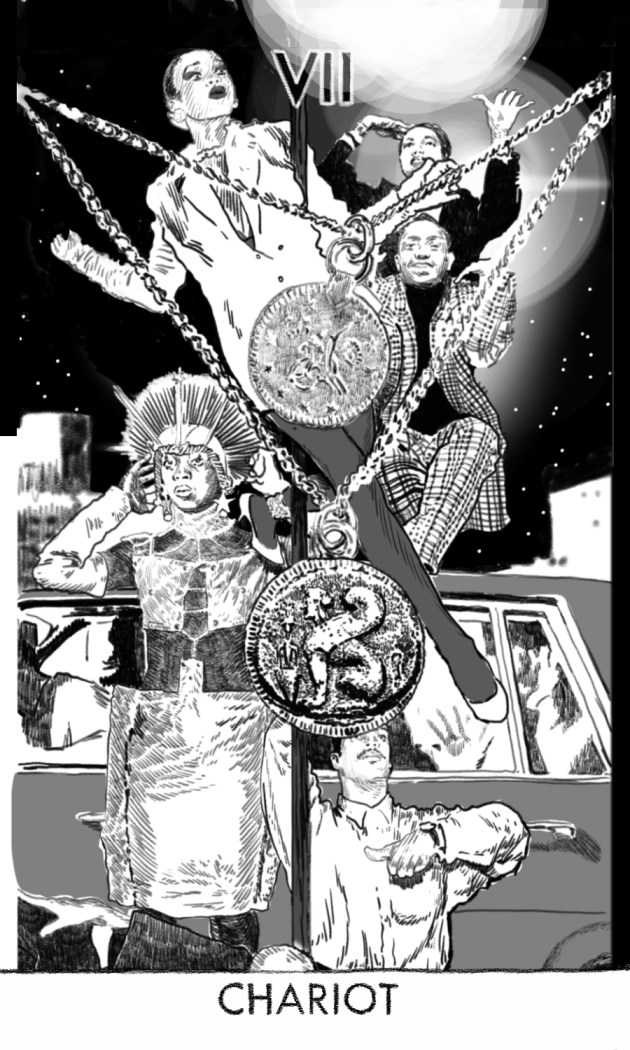
The Chariot card shows a group of languid performers assembled near an impromptu stage down by the piers. These bodies dance a complex and intuited choreography. A lot of energy has been directed towards this night, and yet it unfolds with an effortless wonder. Every one that matters is here, we all showed up to play our part in making tonight legendary. This night is inspired and it is very rowdy. The atmosphere will sweep you off your feet, then take you on a wild ride that you will never forget. Each performer in this dance group brings an indispensable inner quality to the stage. Their friends cheer them on from inside an old Chevrolet wagon.
In front of them an admirer gazes at them through the gold chains with sphinx coins that he dangles out as a prize to be won. His infatuation for one of the dancers grows as he cheers and howls with the crowd. There are many prizes just ahead, admiration and coins are the least interesting among them. The night is still youthful, sexy and a little dangerous. It’s just late enough to let loose and early enough to still be excited about what is about what is coming up next. Tonight anything can happen, you might meet someone, you might be crowned queen of the night, you might dance for a stranger, or throw a brick and start a riot.
No matter what happens tonight, this chariot will gather immense momentum—it can take its passengers to the highest heights and the lowest lows, so be mindful of where you steer your attention.
AT LENGTH:
On June 28th, 1969, New York City Police sent officers to perform a raid at the Stonewall in, in Greenwich Village. Discretion was key to establishments like the Stonewall Inn, it was run by the mafia, you had to know someone to get in, the windows were boarded shut, the entry was tightly guarded by bouncer who would size up patrons from behind a peep-holed door. And yet it was home to a wide array of new york’s queer and street youth. A confluence of events and circumstances turned a routine policing of ‘deviant’ culture into a historic riot and watershed moment for gay-liberation. Everything was ‘off’ from the beginning, the raid began at 1:20 am (much later than the usual raids), the patrons refused to produce identification and comply with orders. Police pushed at the boundaries of their ‘call to duty’, apparently, inappropriately touching and harassing patrons. There was initially no police wagon to collect the confiscated alcohol, and the patrons who were not arrested were released out in front of the bar, where they congregated. Although the cops aggressively pushed or kicked some patrons out of the bar, some customers released by the police performed for the crowd by posing and saluting the police in a camped-up fashion. The crowd roared with applause for the mocking gestures.
By the time the first patrol wagon had arrived the crowd had doubled in size. As they loaded the wagons with seized alcohol and the arrested, the crowd was restless and taken with chanting and slogans, “GAY POWER!!” When a scuffle broke out between a butch-dyke resisting arrest and the cops, she apparently screamed out “Why don’t you guys do something?” as she was thrown in the back of the police wagon.
Turns out they did do something—the collective frustration, belligerence and neighborly gay pride unleashed a storm of riotous aggression. For hours the queers, the fairies and the queens ran amuck, teasing officers with kick-line skirmishes, garbage lit ablaze, and other mischief. At the end of the night this was the Gay Village, when they gave up on the protocols of discretion, it was clear in the Village there are more of us than them.
That summer night and the following nights, came to signal a new trajectory and character in the gay rights movement, a distinct rift with the assimilationist approach of the elder generation of queer activism in New York. The young queens surviving on the Christopher Street Piers didn’t want to quietly conform and work their way into a ‘gay-inclusive’ version of heteronormative capitalism—they weren’t looking for institutional inclusions, they were looking for liberation from these repressive institutions. This nuance and contradiction between the fight for institutional inclusion and institutional abolition continues to be centerpiece of contemporary LGBT+ debates, and broader discourses on the left about the merits of these different approached to political organizing.
FURTHER READING
https://www.nps.gov/articles/000/marsha-p-johnson-sylvia-rivera.html
 monthlysmokeandmirrors.com