“Sometimes we have to do the work even though we don’t yet see a glimmer on the horizon that it’s actually going to be possible.”
― Angela Y. Davis, Freedom is a Constant Struggle.
“Here I am speaking of myself. When I experienced the first strains of a commitment to the cause for freedom. The last thing that I envisioned at that time were ambitions to become a figure known to great numbers of people. At that time I was simply aspiring to do everything I could to give my meager talents and energy to the cause of my people to the cause of black, brown and all racially oppressed and economically oppressed people in this country and throughout the globe”
-Angela Davis, Speech at UCLA, 1972
KEEP SCROLLING DOWN FOR SHORT & LONG EXPLAINATIONS
IN SHORT:
UPRIGHT: Strength, courage, intellectual persuasion, fierce kindness, compassion and identification with the oppressed.
REVERSED: Find inner strength. Be kind to yourself. Believe in yourself, and seek others that believe in you as well. Others are rooting for you. Just be you and make us proud.
IN DEPTH:
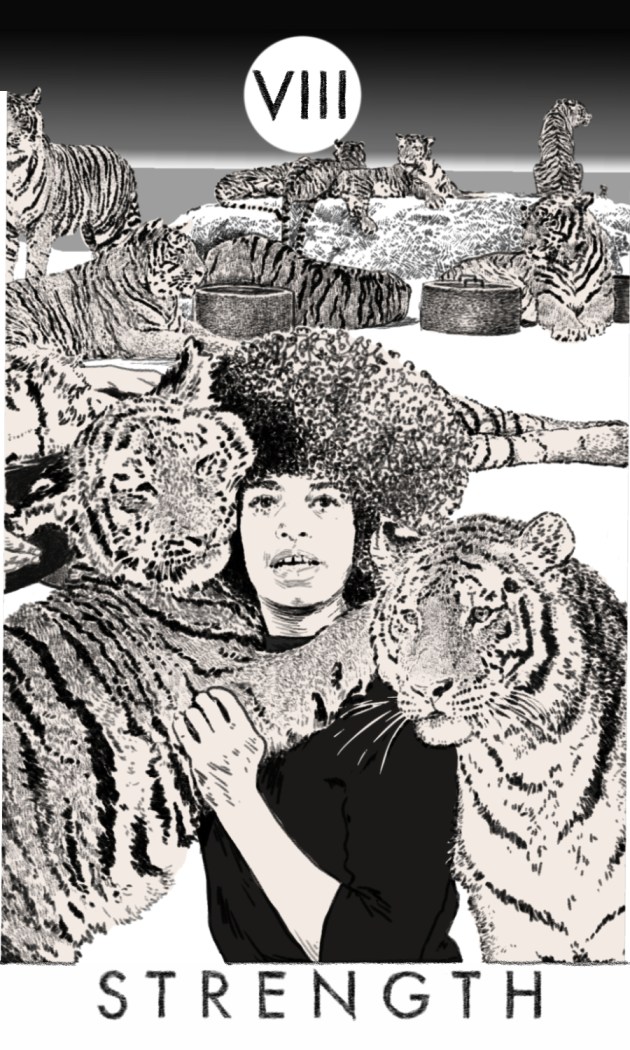
In the Strength card, we see a young woman, grasped in the arms of a tiger. The tiger nuzzles its face against hers. She deserves to be terrified by any measure, and yet she maneuvers around these powerful and unpredictable cats with an uncanny grace. She doesn’t need to find herself in a tiger’s pit to show her incredible courage and inner strength. Wherever she goes she has an implacable ability to turn enemies into unlikely allies and threats into armor.
It is sometimes hard for her to grasp that she is the subject of so much attention, that she is all that different from anyone else—even advisories, students, idols, peers, and tigers. She can tap into the communality between us and inspire feelings of solidarity and connection. She has charming ambivalence about approval, (and the truth is it’s because whether she would admit it out loud, she knows that she is smarter than you. It is disarming, bewitching, and completely banal. She knows we are more powerful together, we need not be exactly the same, and that an injury to one is an injury to all. She is a reluctant legend, who captures the imagination both her admirers and enemies.
AT LENGTH:
Angela Davis (born Jan, 26, 1944) is legendary American Marxist and feminist, abolitionist, activist, philosopher, academic, author, and teacher. She grew up in the “Dynamite Hill” neighborhood of Birmingham Alabama, known at the time for the racist violence and bombings enacted upon the black families that had moved there. She participated in church-organized civil rights protests in her early years. During her University studies she was an esteemed student of Frankfurt School philosophers, Herbert Marcuse & Theodor Adorno. While teaching at UCLA, in 1969, then governor, Ronald Regan attempted (unsuccessfully) to have the Board of Regents fire her for public affiliation with the Communist Party. At the age of 27, she was put on the FBI’s most wanted list. She has faced 3 seperate death sentences in her life, and she has defended herself in court and won. She is the author of indispensable books like “Women, Race, & Class”, and “Are Prisons Obsolete”. Angela Davis is undeniably and ‘exceptional’ person, and yet she holds profoundly anti-hierarchical ambivalence to this kind of title of a special exception. The preface to her autobiography opens with a characteristic self-reflection,
“Writing an autobiography at my age seemed presumptuous. Moreover I felt that to write about my life what I did what I thought and what happened to me would require a posture of difference and assumption that I was unlike other women other black women and therefore needed to explain myself I felt that such a book might end up obscuring the most essential fact the forces that have made my life what it is are the very same forces that have shaped and miss shaped the lives of millions of my people.”
The Strength card wants to consider the type of power and empowerment that gracefully rides waves of attention—threats & fan-fare alike. Strength handles the pressure well, because she knows it’s not entirely about her. One could mistake this as simple humility, but it is rooted in something more complicated—like seeing oneself through the lens of a sociologist. The Strength card is not afraid to sit with the tigers, because she can inspire shared cause in the hearts of even tigers. And she can call their attentive gaze towards an improved horizon.
FURTHER READINGS:
Angela Davis, An Autobiography. Angela Davis, 1973
Women, Race & Class. Angela Davis, 1981
 monthlysmokeandmirrors.com