IN SHORT:
UPRIGHT: Negative thoughts, self-imposed restriction, imprisonment, victim mentality, Meloncholic attachments. Fatalism and dystopian world building
REVERSED: Self-limiting beliefs, inner critic. Difficulties releasing negative thoughts. Try opening up to new perspectives. Shadow self, cruel self-talk. stagnant self image.
KEEP SCROLLING FOR IN DEPTH EXPLANATION
IN DEPTH:
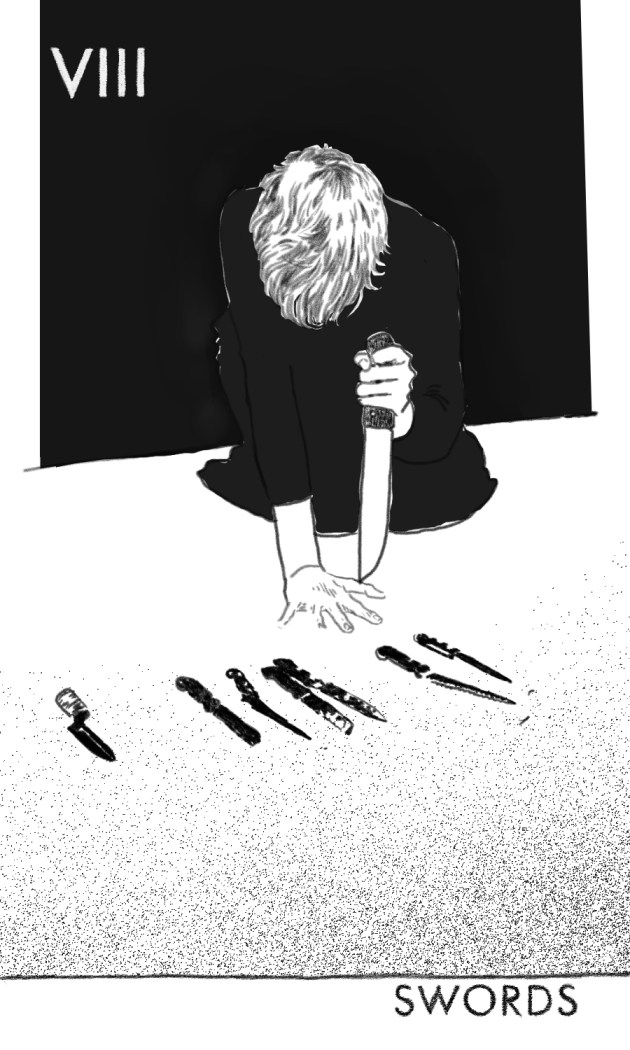
The Eight of Swords shows a figure, head hung low as she plays a five-finger knife game. She is alone, and crouched down on barren floor where she is speeds up the pace with which she can attacks the space in between her digits. Directly, in front of her seven knives are placed in front of her, one to remind her to return to this ritual everyday of the week. She feels that this is simply something she has to do. What began as an eccentric self-soothing habit has become a dysfunction of which she feels powerless.
This card indicates feelings of emotional intensity and being trapped within circumstances or repetitive patterns. When one looks ahead all options seem to lead to the same outcome—again and again. However like this figure featured in the Eight of Swords, you may likely be in a trap of your own making. This card is a reminder of the ways in with rituals, habits, and the stories we tell ourselves about ourselves can become a significant constraint to our own growth. Be aware of the ways you self-regulate and self-soothe, that may in fact be harmful.
The Eight of Swords presents the opportunity to witness ourselves in the grips of a belief that no longer serves our best interests. To witness ourselves at the mercy of our own inner-critic, bending the will to change through endless internal negative chatter. In these Eight of Swords moments, we are asked to simply watch ourselves with sympathy and compassion and ask, what am I telling myself about myself with these habits, and what beliefs do they serve to protect? Through this we can acknowledge the ways that these habits and selective narratives are powerful tool of self-mythologizing, and we can work towards being intentional about how to tell the story of who we are in this life.
………………………………………………………………………………………………………………
“Melancholy betrays the world for the sake of knowledge. But in its tenacious self-absorption it embraces dead objects in its contemplation, in order to redeem them.”— Walter Benjamin
‘The only pleasure the melancholic permits himself, and it is a powerful one, is allegory’ -Walter Benjamin, The Origin of German Trauerspiel
 monthlysmokeandmirrors.com