IN SHORT:
UPRIGHT: Creative and inventive approach. Intuition, curiosity, possibility. Enjoyable social opportunities, with limited outcomes.
REVERSED:
Creative blocks. Dealing with incongruent emotional & political desires and immaturity. Beware comrades who believe in a theoretical feminism, yet have a tendency of dismissing female peers with gender based assumptions and often ask small highly gendered favors (ei. performing care roles like cleaning, cooking, or frequent consoling and ego stroking.) Sometimes the greater power lies in disappearing into oneself and craft. Keep working at it under the radar. Invisibility is a skill too.
KEEP SCROLLING DOWN FOR IN DEPTH EXPLANATION
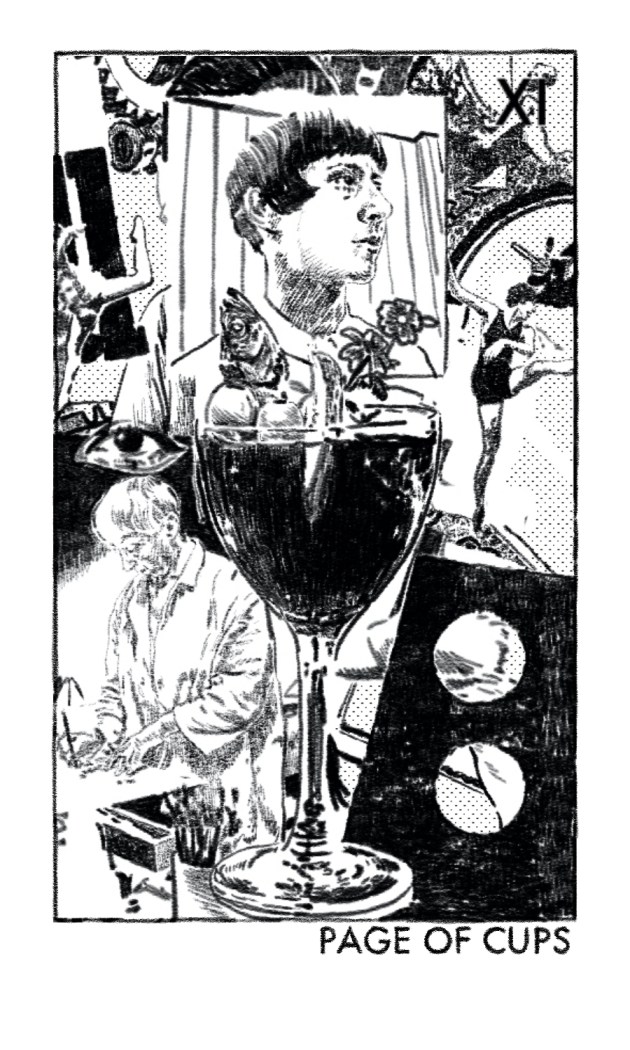
“I wish to blur the firm boundaries which we self-certain people tend to delineate around all we can achieve,”
-Hannah Höch quoted in Dietmar Elger’s book, Dadaism.
DESCRIPTION:
The Page of Cups is a brilliant artist and proto-androgen of the Weimar Republic. Because it is the 1920’s she uses she pronouns, but she is worlds beyond that. A face perfectly its own, gazes into the future. Unfazed by petty and dismissive criticism, because they don’t seek the approval of authority… or anyone else for that matter.
This Dadaist Page of Cups finds validation within themselves, within their artistic impulses, within their joy, and within an impassioned political instinct. This self-assuredness emerges from an attentive knowing of self, and everything that our Page has placed within their cup. The stem is tall; the glass is filled with a hearty mixture of tomato juice, vodka, and heat; the garnishes are many: dandelions, anchovy, olives. You might be thinking “so the Page of Cups is offering a classic brunch cocktail?” No. Well… maybe.. but moreover, what the Page of Cups offers is always imbued with keen personalized expressions and an experimental wonder that is too often mistaken for naiveté or illegitimate. Instead it is a highly cultivated secret language, which reads as silly nonsense to misogynists.
The Page of Cups joins us from the heights of Weimar’s cultural liberation, and gleefully asks for more. This Page is based on the german Dadaist Hannah Höch, who described herself as a “cultural bolshevik” and was the last living figure of this group of ‘degenerate artists’ to have survived the Fascism of the Third Reich. She did so by making loud art quietly in a hidden garden home.
RANDOM SIDE NOTES:
“Many of Höch’s overtly political photomontages caricatured the pretended socialism of the new republic and linked female liberation with leftist political revolution” (Lavin).[24]
“a caustic short story” entitled “The Painter” in 1920, the subject of which is “an artist who is thrown into an intense spiritual crisis when his wife asks him to do the dishes.”[10]
 monthlysmokeandmirrors.com