IN SHORT:
UPRIGHT: Curiosity, intellectual generosity and a rigorous thirst for knowledge. New sub-cultural forms of communicating and forming community. New Ideas and intellectual communities.
REVERSED: Cultivate a personal voice. Commit time to private acts of self-expression. Speaking in haste & hero worship. All talk.
KEEP SCROLLING DOWN FOR IN DEPTH EXPLANATION
IN DEPTH:
“The only solution to pollution is a people’s humane revolution.“
-Speech at the “Free John Sinclair” concert in Ann Arbor, Michigan (December 1971)
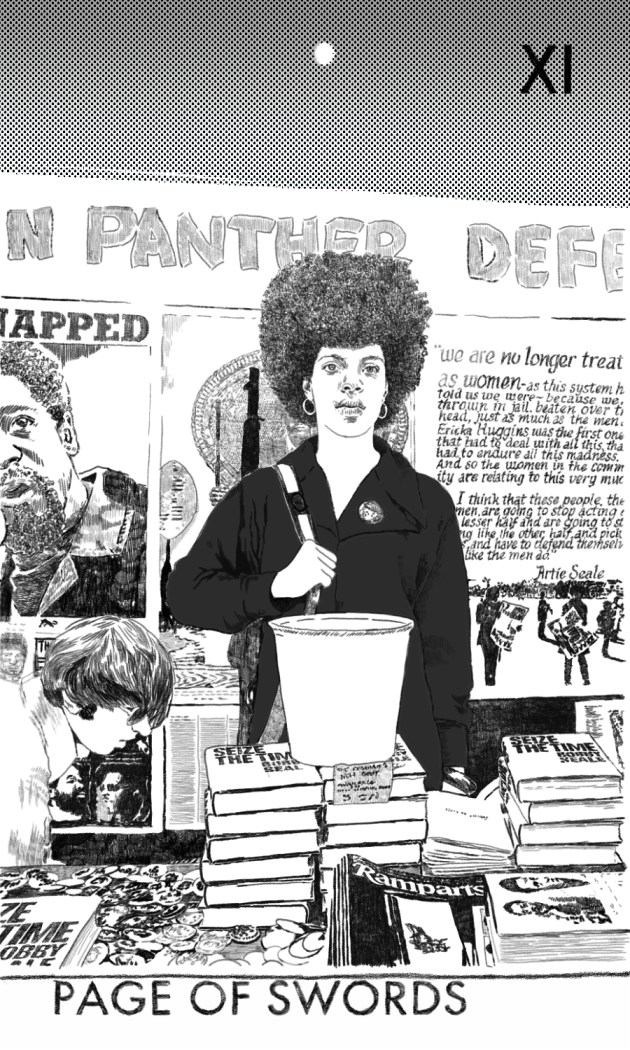
The Page of swords show as compelling woman standing with a rifle on her shoulder and a table stacked with books, pins, magazines and a bucket for cash collection and donations. Behind the table a wall of posters featuring heroes of the movement, Bobby Seale and Fred Hampton. Next to her a young man scurries about checking inventory and trying to impress upon her his usefulness. Today they are tabling for the Black Panthers at a local collage during an anti-war rally.
Upright, she stands with the gun she has been given, adjusting the position and weight from the shoulder strap. She is still learning her relationship to self-defense. But this is one of the strongest qualities of her magnetism: she exists from that disarming state of youthfulness, which approaches the world with trust and wonder. Her intellectual eagerness is infectious. She believes at her core that it is possible to put in the work and build the kind of grass-roots movement that would make the politics of the past obsolete.
She has devoured all of the literature in front of her, and she brims with fresh ideas and observations. She operates from a the kind of curiosity and intellectual excitement that attracts like-minded friends and communities. The Page of Swords benefits greatly from relationships that can engage her vibrant intellect. The dynamism inherent to discussion seem to sharpen and excite her analysis of the world around her.
She is not ashamed to be a ‘fan’ of that which she admires and aspires towards. The pride and excitement she shows towards her community only amplifies the pride they feel while watching her learn to step into her power and inner-strength. She is loved by her community, although sometimes the energy she brings to to her peers is taken for granted and even taken advantage of.
In Reverse the Page of Swords recedes into the scene, she becomes a face among faces. She is weighed down by hero worship and idolizing her peers. Despite the rigors and commitment of her intellect she is prone to belittling herself, underestimating her worth, and feeling that she has not met some imagines criteria that would make her voice of worth for the public. When the Page of Swords stares at us upside down from across a table of literature and movement merch, we know that there is a risk of loosing oneself within a group or social scene. Despite the Page of Swords tendency to be surrounded by the clamorous voices of her community, she reminds us of the need to take a step back occasionally and get in touch with our own inner-struggle, lest we burn-out. This card reminds us to take time to ourselves to develop our own unique voice. Make use of journaling, photography, zine-making and other forms of create self-expression, your voice matters, leave records for the future. In reverse the Page of Swords imparts the importance of developing our own voice and becoming the author of our place in the world, rather than simply being a participant in it.
The Page of Swords takes it’s inspiration from the generation of radicals and organizers inspired by the Black Panthers community organizing and the Ten-Point Program. The Ten-Point Program was a document created in 1966 by the founders of the Black Panther Party, Huey P. Newton and Bobby Seale. It features a set of detailed guidelines to the Black Panther Party and states their ideals and operational principles, a “combination of the Bill of Rights and the Declaration of Independence.” However before this iconic document was published and became widely known, it was a collection of numerically organized hand-written statements, with typos and amendments. The collaboration and organizing that happened between Newton and Seale not only ushered new generation of political organizing but also opened up towards a black power and liberation as a culture of empowerment and claiming new modes of authorship, authority, solidarity and self-defense.
Below is the abbreviated list of the Ten Points, of the Ten-Point Program:
1. We want freedom. We want power to determine the destiny of our black and oppressed communities.
2. We want full employment for our people.
3. We want an end to the robbery by the capitalist of our black and oppressed communities.
4. We want decent housing, fit for the shelter of human beings.
5. We want education for our people that exposes the true nature of this decadent American society. We want education that teaches us our true history and our role in the present-day society.
6. We want completely free health care for all black and oppressed people.
7. We want an immediate end to police brutality and murder of black people, other people of color, all oppressed people inside the United States.
8. We want an immediate end to all wars of aggression.
9. We want freedom for all black and poor oppressed people now held in U.S. federal, state, county, city and military prisons and jails. We want trials by a jury of peers for all persons charged with so-called crimes under the laws of this country.
10. We want land, bread, housing, education, clothing, justice, peace and people’s community control of modern technology.
When in the course of human events, it becomes necessary for one people to dissolve the political bands which have connected them with another, and to assume, among the powers of the earth, the separate and equal station to which the laws of nature and nature’s God entitle them, a decent respect to the opinions of mankind requires that they should declare the causes which impel them to the separation.
We hold these truths to be self-evident, that all men are created equal; that they are endowed by their Creator with certain unalienable rights; that among these are life, liberty, and the pursuit of happiness. That, to secure these rights, governments are instituted among men, deriving their just powers from the consent of the governed; that, whenever any form of government becomes destructive of these ends, it is the right of the people to alter or to abolish it, and to institute a new government, laying its foundation on such principles, and organizing its powers in such form, as to them shall seem most likely to effect their safety and happiness. Prudence, indeed, will dictate that governments long established should not be changed for light and transient causes; and, accordingly, all experience hath shown that mankind are more disposed to suffer, while evils are sufferable, than to right themselves by abolishing the forms to which they are accustomed. But, when a long train of abuses and usurpations, pursuing invariably the same object, evinces a design to reduce them under absolute despotism, it is their right, it is their duty, to throw off such government, and to provide new guards for their future security.”
 monthlysmokeandmirrors.com