IN SHORT:
UPRIGHT: Focused Work. Perseverance and commitment. Reciprocating Recognition.
REVERSED: Strained performance of self. Double Consciousness. Oscillation between perfectionism and outbursts. Feeling trapped by how one is perceived by others.
KEEP SCROLLING DOWN FOR IN DEPTH EXPLANATION
Superiority? Inferiority? Why not simply try to touch the other, feel the other, discover each other?”
― Frantz Fanon, Black Skin, White Masks
IN DEPTH
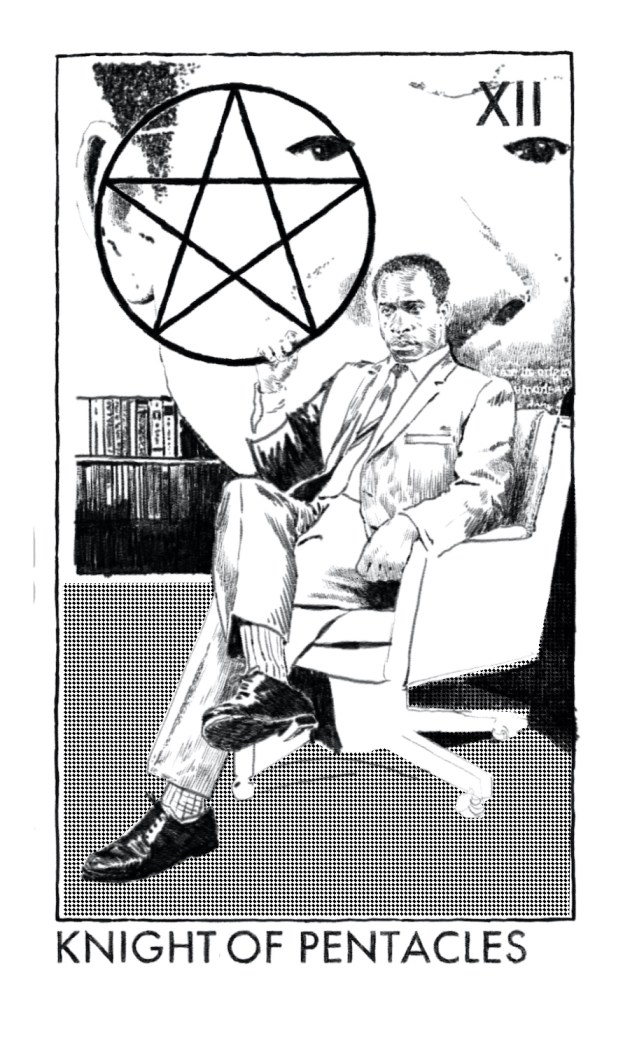
The Knight of Pentacles sits on a swiveling armchair, subtly rocking back and forth. But make no mistake, he’s in absolutely no rush whatsoever—his gaze is fixed on his patient. Behind him, a long shelf houses his extensive research, notes, case studies, and texts from the written traditions of Marxism, Négritude, and Existentialism. As he listens he tenderly thumbs at an imagined pentacle, this fidgeting gesture brings him closer to a grounded experience of himself within this psychoanalytic scene. ‘What am I to you? What are you to me?’ His erudite presentation gives no hint of the intense internal struggle and perseverance. As a psychiatrist the Knight of Pentacles, is laser focused on better understanding the emotions and symptoms bound up in the ‘psychology of oppression’.
Our Knight of Pentacles features the French West-Indian psychiatrist and political-philosopher Frantz Fanon (20 July 1925 – 6 December 1961). He is a cornerstone of anti-colonial thinking. He spent the majority of his life between the French African colonies (Martinique, Tunisia, and Algeria) and France itself. A practicing psychiatrist, Fanon did his initial residency at Saint-Alban-sur-Limagnole under the radical Catalan psychiatrist François Tosquelles, who emphasized the role of culture in psychopathology. It was from this time that he completed his first book Black Skin, White Masks(1952), an analysis of the negative psychological impact of colonial subjugation on black people. He was thrown out of the first editorial meeting with Francis Jeanson regarding the book after responding to commentary with the statement, “Not bad for a (…), is it?” Despite this confrontation, together they published the book and developed a deep mutual respect for one another.
During the 1954 outbreak of the Algerian revolution, Fanon became clandestinely involved with the Front de Libération Nationale. All the while working at a French hospital in Algerian, where he is was tasked with psychological treatment of both the French officers who carried out torture to suppress the brewing anti-colonial sentiments, as well as the Algerian victims of this torture. By the summer of 1956 he resigns, no longer able to maintain this double consciousness of being an inadvertent agent of the french colonial state by way of his work with the hospital. Our Knight of Pentacles is determined to understand and deconstruct the logic of domination and dominion that is core to colonization. What psychological forces animates this the experience of oppression? He listens to every detail of the pain, because he needs to know why we are like this—as much for his own peace of mind, as that of his patients.
 monthlysmokeandmirrors.com