“Ladies and Gentlemen, I urge you therefore to exercise a certain patience with respect to the relations between theory and practice. Such a request may be justified because in a situation like the present—one about which I do not entertain the slightest illusion—and nor would I wish to encourage any illusions in you – whether it will be possible ever again to achieve a valid form of practice may well depend on not demanding that every idea should immediately produce its own legitimate in document explaining its own practical use. The situation may well demand instead that we resist the call of practicality with all our might in order ruthlessly to follow through an idea and its logical implications so as to see where it may lead.”
-Theodor W. Adorno, The Problem of Moral Philosophy.
“If, to the living, objective reality seems deaf as never before, they try to elicit meaning from it by saying abracadabra. Meaning is attributed indiscriminately to the next worst thing: the rationality of the real, no longer quite convincing, is replaced by hopping tables and rays from heaps of earth.”
-Theodor W. Adorno, Theses Against Occultism.
PLEASE SCROLL DOWN FOR SHORT AND LONG EXPLANATIONS
IN SHORT:
UPRIGHT: Pause, trials, circumspection, discernment, sacrifice, research, dialectical thinking, new perspectives.
REVERSED: Delays, resistance, stalling, indecision, bombastic positions, the crowd mentality, body politic
AT LENGTH:
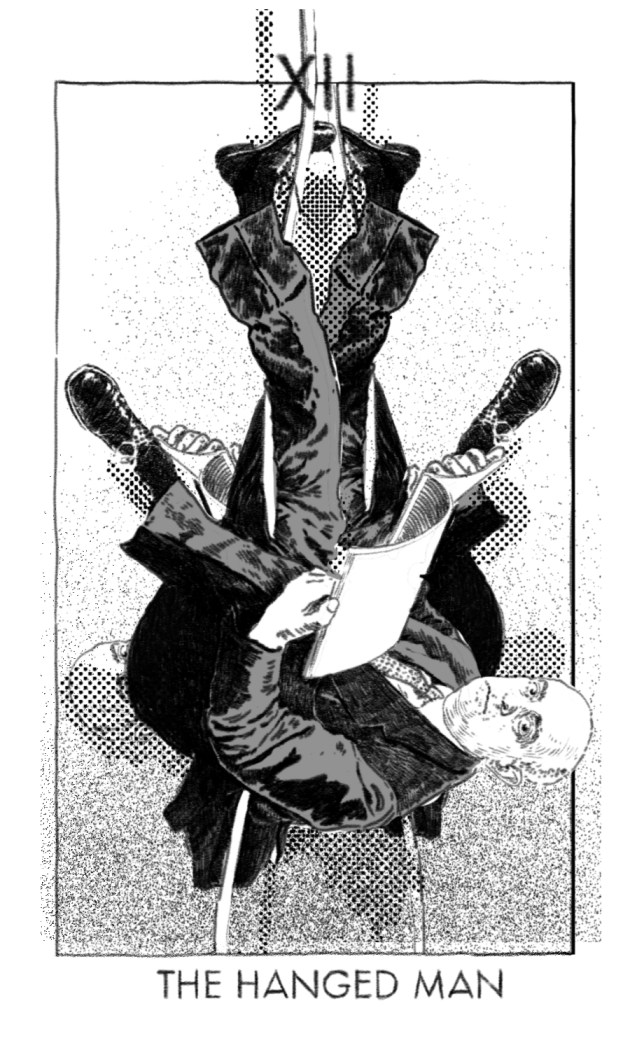
The Hanged Man is shown upside down, his arm and leg clasped to a rope, while he considers the text before him. This is not who he is, it is simply how he appears. He is both static in his focus, and yet the bombast with which he speaks can be dizzying. His posture is calm and almost jaunty as he addresses us while twirling and suspended mid air. He has positioned himself to uniquely to be an arbiter of music, literature, popular culture, and history. Question him directly, and he will dance circles around your position, and deliver the world you thought you knew, entirely upside down. The hanged man thrives when confronted with questions and contradiction, he found philosophy at an early age and quickly learned a “kind of coded text from which the historical situation of spirit could be read”. A man of letters: his friends and collaborators would describe him as a genius, capable of simply speaking cogent works of critical theory into existence, and yet many of his critics would describe his work as unreadable.7 Regardless of criticism, the Hanged Man is a man that other brilliant thinkers want to be in the company of, because he can help us see the world from a wholly new vantage points. As he gently sways from the rope with which he hangs himself, when asked for guidance, he suggests not so gently that we consult intellectual sources outside of these cards and pages, and cultivate our ability to read and interpret the world criticality, rather than dabbling in games of intuition, and guru seeking.
IN DEPTH:
The Hanged Man is shown upside down, his arm and leg clasped to a rope, while he considers the text before him. This is not who he is, it is simply how he appears. He is both static in his focus, and yet the bombast with which he speaks can be dizzying. His posture is calm and almost jaunty as he addresses us while twirling and suspended mid air. He has positioned himself to uniquely to be an arbiter of music, literature, popular culture, and history. Question him directly, and he will dance circles around your position, and deliver the world you thought you knew, entirely upside down. The hanged man thrives when confronted with questions and contradiction, he found philosophy at an early age and quickly learned a “kind of coded text from which the historical situation of spirit could be read”. A man of letters: his friends and collaborators would describe him as a genius, capable of simply speaking cogent works of critical theory into
33
existence, and yet many of his critics would describe his work as unreadable.7 Regardless of criticism, the Hanged Man is a man that other brilliant thinkers want to be in the company of, because he can help us see the world from a wholly new vantage points. As he gently sways from the rope with which he hangs himself, when asked for guidance, he suggests not so gently that we consult intellectual sources outside of these cards and pages, and cultivate our ability to read and interpret the world criticality, rather than dabbling in games of intuition, and guru seeking.
IN DEPTH:
Theodor W. Adorno (11 Sept 1903 – 6 Aug 1969) was a German philosopher, sociologist, psychologist, musicologist, and composer. A central figure within the Frankfurt School of critical theory, he was a friend and intellectual partner to thinkers such as Ernst Bloch, Walter Benjamin, Max Horkheimer, Erich Fromm, and Herbert Marcuse. This group of german thinkers shared a penchant for a critique of modernity and the works of Freud, Marx, and Hegel. He was a classically trained pianist whose sympathies with the twelve-tone technique of Arnold Schoenberg led him to study composition with Alban Berg of the Second Viennese School developing theories around atonal musicology and his own original compositions. His dedication to avant- garde music served as the inspiration for many subsequent writings and led to his collaboration with Thomas Mann on the latter’s novel ‘Doctor Faustus’ while the two men were living in exile in California during the Second World War. During this time as an emigre in the US, he worked on ‘the Dialectic of the Enlightenment’ with Max Horkheimer, wrote a study critical of popular astrology in America, and regularly corresponded with Walter Benjamin who was attempting to escape the Third Reich and make safe passage off-continent. By the time the war was over, and Adorno was returning to life in Germany, he was a well-known critic of fascism and what he termed the “culture industry” under capitalism. His books ‘Dialectic of Enlightenment’ (1947), ‘Minima Moralia’ (1951) and ‘Negative Dialectics’ (1966), had gained significant influence within the European New Left. However by 1968, while teaching at Free University Berlin, he had caught the ire of the german student movement, due to his refusal to take an explicit position on many issues of concern including the war in Vietnam, and US imperialism, this was further aggravated when he defended his pupil, Jurgen Habermas, becoming the subject of taunts, pranks, and regular disruptions to his lectures and seminars by student activists.
Adorno had planned two seminars on the dialectics of subject and object as well as a lecture course called “Introduction to Dialectical Thinking” planned for the summer semester. Shortly after introductions, a student wrote “If Adorno is left in peace, capitalism will never cease” on the blackboard, then three female students came up to the lectern, baring their breasts, and threw flower petals over his head. Adorno’s attempt to open the lecture and welcome questions whenever they arose degenerated into a disruption, from which he quickly fled and called the police. Adorno nevertheless persisted in opposing broad condemnations of the protest movement, which would have only served to support the conservative claim that Adorno’s teachings were the cause of political upheaval. In his personal letters to Herbert Marcuse on these matters he elaborates:
“You object to Jürgen’s expression ‘left fascism’, calling it a contradictio in adjecto. But you are a dialectician, aren’t you? As if such contradictions did not exist—might not a movement, by the force of its immanent antinomies, transform itself into its opposite? I do not doubt for a moment that the student movement in its current form is heading towards that technocratization of the university that it claims it wants to prevent, indeed quite directly. And it also seems to me just as un- questionable that modes of behavior such as those that I had to witness, and whose description I will spare both you and me, really display something of that thoughtless violence that once belonged to fascism.”
After ongoing interruptions, stunts in the classroom, and much strife, he cancelled his lectures series for the remainder of the seminar and only conducted his philosophy session. Adorno, exhausted from these endeavors, visited Zermatt, Switzerland, at the base of the Matterhorn in the summer of 1969 to regain his vigor, and work on his writing. He died of heart attack on August 6.
FOOTNOTE:
“Pied Pipers and Polymaths: Adornos Critique of Praxism – Adrian Wilding. In this essay Wildling describes the English philosopher Brian Magee articulating a (not uncommon) sentiment that Adorno’s writing as alienating the reader, and Herbert Marcuse defense of Adorno as a ‘genius’.
 monthlysmokeandmirrors.com