“Our economic system and our planetary system are now at war. Or, more accurately, our economy is at war with many forms of life on earth, including human life. What the climate needs to avoid collapse is a contraction in humanity’s use of resources; what our economic model demands to avoid collapse is unfettered expansion. Only one of these sets of rules can be changed, and it’s not the laws of nature.”
― Naomi Klein, This Changes Everything: Capitalism vs. The Climate
“We live in capitalism. Its power seems inescapable. So did the divine right of kings. Any human power can be resisted and changed by human beings.”― Ursula K. Le Guin
KEEP SCROLLING DOWN FOR SHORT AND LONG EXPLANATIONS
IN SHORT
UPRIGHT: An ending. Imminent change. Transformation & transition is called for. Re-imagine expectations.
REVERSED: Avoidance of external changes and inner transformation. Beware Malthusian Solutions. And criticism that hide problems born of stubbornness or acquisitiveness.
AT LENGTH:
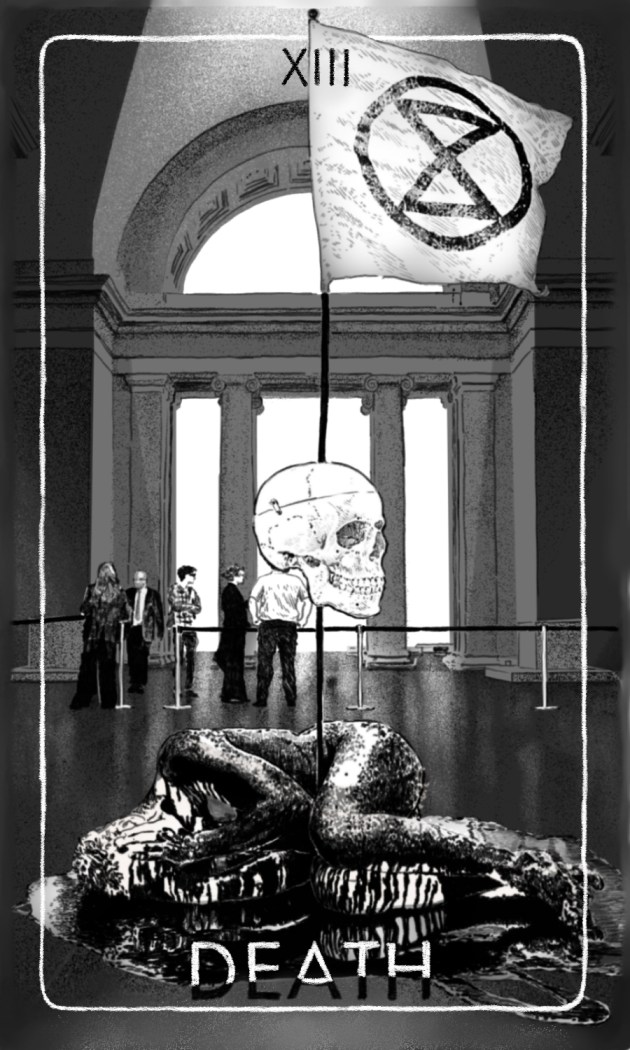
The Death card shows a young artist curled up on a museum’s floor. They have been covered in something that looks like crude oil, and their body writhes around—not from pain, but something less embodied, something that dissolves into the puddle surrounding them. Directly above, stands an ominous prop: a tall pole that displays a human skull and the flag of extinction rebellion. The artist knows that political stunts like this will not make him popular around his artistic peers. But he feels time running out, and he can see little choice other than to join local activist—because it’s hard to imagine ‘art’ or ‘art history’ surviving climate change, unless we expand the art of protest.
In the background the museum managerial staff discuss with security guards a strategy to end this uninvited performance, and escort the unwanted activists outside and back out to the streets. Just behind the museum’s rotunda where the staff gathers, the late afternoon light is bright and bleary. The Death card is here to remind us that very soon something is going to have to come to an end. The artist/activist must eventually vacate the premise, but also the museum must eventually divest from the butchers of the planet. One will happen today the other a future tomorrow. Change and transformation is unavoidable, so get ready to say goodbye to the way things are.
The Death card shows us that “this will not and cannot continue”. It is card that signals towards the end of a world—so that a new world may begin.
IN DEPTH:
In 2016 British Petroleum (BP) decided to end its 26-year sponsorship of the Tate museums (on of Britain’s highest profile cultural institutions. The oil company in their official statement blamed an “extremely challenging business environment”. And denied that the many years of spectacular public protest regarding this sponsorship had anything to do with the decision. However it certainly ought to be claimed as a victory for groups like the art collective Liberate Tate, which staged protests calling attention to the relationship and the way BP uses institutions like the Tate to greenwash their brand and deflect criticism of their company.
The Liberate Tate collective was founded during a Tate workshop on ‘art & activism’ when Tate curators tried to censor the workshop from making work against Tate sponsors. Initially no such artworks or interventions had been planned, but once the policy was made explicit to the participants, some were inspired to form an outside collective to address this very issue.
When they began staging works like “Dead in the Water”, many likely thought it a hollow criticism or impossible demand. But six years of making artwork that direct public attention to the social and environmental destruction that big oil relies on… and almost out of nowhere suddenly the ‘business’ climate has become too ‘challenging’ and now something previously impossible becomes possible: BP and the Tate end their public financial relationship.
During this time and onwards there has been a significant swell in art & activism from groups like #OccupyMuseums and G.U.L.F (Gulf Labour Coalition); who have demanded that museums divest from some of the most morally repugnant donors and board members. These demands may seem unrealistic to some, or to others it may appear as ‘bad art’8 , regardless they are performing important ‘public service announcements’ reminding us who is it that sits atop and benefits from these large cultural institutions. But if you are being presented with the Death card, it is a reminder to see the unspoken contract that is put before you, and know that you don’t have to co- sign, or co-operate, you can walk away, you can break this contract, you can be a part of building something better.
Eventually the contracts of the past can no longer hold us. Everything expires over the great expanses of time. Nothing is permanent and their are few true guarantees. But this need not scare us, this is when we have the greatest opportunity to heal, grow, and change.
FURTHER READINGS: https://news.artnet.com/art-world/light-projections-guggenheim-museum- gulf-484280
8 Here I am thinking of Claire Bishop’s “but is it good art”approach to social practice: https://www.versobooks.com/blogs/
1071-all-the-world-s-a-stage-no-really-claire-bishop-on-participatory-art-and-artificial-hells

https://archive.nytimes.com/artsbeat.blogs.nytimes.com/2015/04/15/before-its- opening-the-whitney-museum-faces-a-protest/
https://www.theguardian.com/artanddesign/2016/mar/11/bp-to-end-tate-sponsorship-climate-protests
https://www.theguardian.com/world/2020/jul/29/population-climate-change-and- inequality
 monthlysmokeandmirrors.com