IN SHORT:
UPRIGHT: Self-confidence, independence, social skills, determination, the motivating power of the past. Creativity and creation.
REVERSED: Self-respect, quiet confidence, introverted, need to re-establish sense of self. scorned or thwarted ambitions. Restless.
KEEP SCROLLING FOR IN DEPTH EXPLANATION
IN DEPTH:
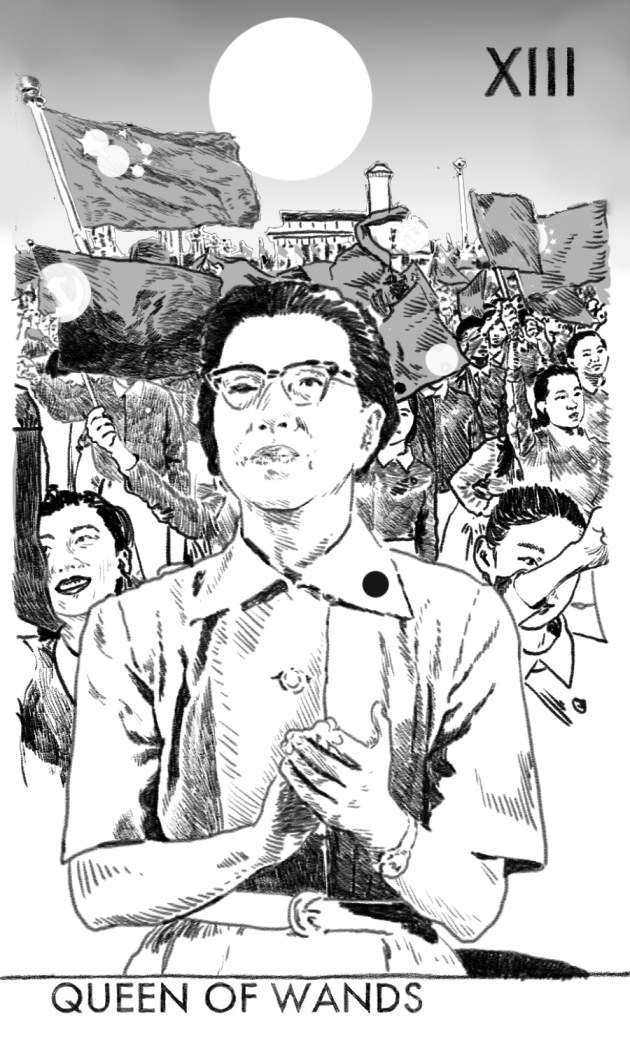
The Queen of Wands stands atop a crowd of devotees cheering. This type of fanfare is just one of the results of treating life as a fantastic story that we will into existence. She claps furiously in perfect rhythm with the flags and drumming behind her, almost as if she is the composer directing the world like a beautiful piece of theater. As she gazes off into the distance she radiates an uncanny youthfulness that defies her own age and wisdom. She appears as fiery, playful, petty or dour depending on who was being impressed upon her. She is drawn to power and politics as a verb. She has a tendency to towards being both blindsided by events and paranoid in her need to anticipate what will come next. To view oneself as a grand protagonist in the story of ones own life, can be both a powerful gift and equally powerful curse. Either way it is unrelenting and all encompassing work.
The Queen of Wands imagines Jiang Qing (19 March 1914 – 14 May 1991), also known as Madame Mao, was a Chinese communist revolutionary, actress, and major political figure during the Cultural Revolution. She was Mao’s fourth wife, and Mao was her second husband. She married Chairman Mao in a small ceremony in November 1938 and despite some opposition served as the inaugural “First Lady” of the People’s Republic of China. Jiang served as the Chairman’s personal secretary in the 1940s and used this power of association to take over much of Shanghai’s culture industry. She collaborated with Lin Biao to advance Mao’s cult of personality and unique brand of Communist ideology.
At the height of the Cultural Revolution, Jiang held significant influence not only state affairs, but more importantly in the realm of the cultural and emotive propaganda. She held the power to direct and magnify the fury of the younger generations towards the stalwart authorities of the past. Her revolutionary vision is a permanent one, an endless overthrowing. Charismatic and reviled, she was a master of political theater, and back-stage politicking.
Having derived most of her legitimacy as a leader from Mao, she often found herself as odds with other top statesmen. She collected many enemies along her political career—and just as she sought vengeance upon her enemies, her enemies sought vengeance upon her. Not long after Mao’s death, in 1976 she was arrested by Hua Guofeng and his allies, and was subsequently condemned by the party. Her trial and sentencing was used an opportunity to scapegoat away the damages and sufferings of the revolution. She was initially sentenced to death, then commuted to life imprisonment in 1983. When Jiang was released for medical treatment, she ended her own life by suicide.
…………………………………………
“Sex is engaging in the first rounds. What sustains interest in the long run is political power.”
-Jiang Qing
“I am without heaven, and a law unto myself. It is right to rebel.”
-Jiang Qing
“There can be no peaceful co-existence in the ideological realm. Peaceful Co-existence corrupts.”
-Jiang Qing
 monthlysmokeandmirrors.com