IN SHORT:
UPRIGHT: Intellectual clarity, social authority, audacity. Making use of shared conditions. Communality and differences. Impulses towards letting loose.
REVERSED: Social power dynamics, expansion of leadership, breaking rank, in-fighting, schisms, leadership contests.
KEEP SCROLLING DOWN FOR IN DEPTH EXPLANATION
IN DEPTH:
“There is no even template. We must take a look first at, “Time, place and conditions within each community” to determine how we can come together.”
-Cha Cha Jimenez, http://www.fightbacknews.org/2019/7/1/interview-jose-cha-cha-jimenez-original-rainbow-coalition
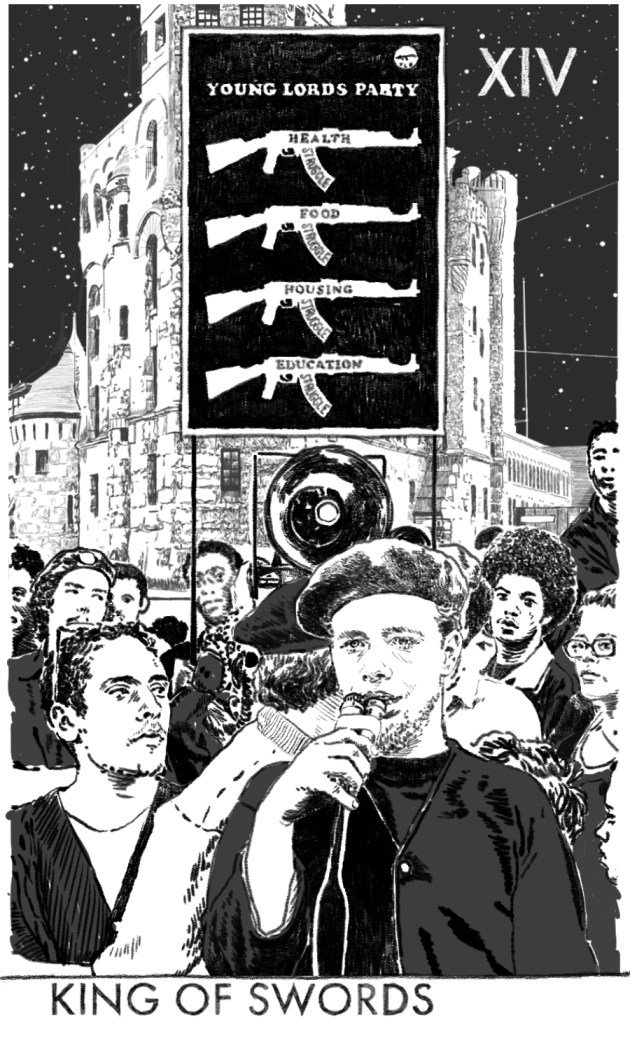
The King of Swords stands on the frontlines, his voice is broad-cast to the the crowd gathered defiantly in the streets after dark. He is giving direction to his comrades, and is ready to confront any situation that might come his way. He holds a microphone his right hand, he speaks with clarity and candor, his left hand is out-of-sight, as if to imply he may be hiding some tricks up his sleeve. He is equal parts of seductive charisma and menacing audacity.
The King of Swords upright, is a ‘man of the people’. He is the type of intellect that is born of ‘street-smart’s’, which is to say that he is both instinctive, decisive, and yet, flexible and open to developing his perspective through conversation and working with others. He blends seamlessly his keen intuition with a well-informed analysis. He wears a purple and black cardigan and beret, invoking political, national, and social alliances. Behind him there is a hush in the crowd, a recognition that this most recent street-offensive has elevated the stakes of the struggle.
His cadre hands him the mic because he is deft communicator, whether it be with competing gangs, city-hall, or the media. But don’t be mistaken, he’s not ‘all-talk’ he knows nothing changes unless someone steps up and takes directed action. He has no problem stepping into these leadership roles, because ‘someone’s gotta do it, not later, but right now’. He often appears to others as an expert or authority on the subjects at hand, and comrades and aligned groups seek his approval or inclusion. While the King of Swords may appear at ease with the authority bestowed upon him, infact the pressures can bring emotional exhaustion, and desire to release control through addiction or transgressive activities.
The King of Swords in reverse calls for a leadership style that is more collaborative and shines in conversation and in the of company of an inner-circle. This card in reverse is indicative of a fierce and active intellectual. When we look and this hushed crowd upside down, the scene opens up to the surrounding faces. Now, the faces appear to be considering more than the speech in the foreground. Reversed this scene points to a group with competing voices, ideas, interests, and approaches. Here we can learn and grow from our differences. Many of these faces are conscious of the media taking their picture in this moment, some are performing what they imagine revolutionary listening to look like, and others are simply waiting for a prompt to speak to, and others rehearse in depth response in their head. On this starry night, there will be a multitude of speakers, each one elevated by its difference from the last. When these faces are gathered upside down around the King of Swords, there may be an imminent contest for authority in a group, ‘back-talking’, and splinter groups. This is a card of social and political whirlwind, in which we may find ourselves in deep connection with the times one day, and the following day a sudden disconnect to our beliefs or the those of others.
Our King of Swords is takes direction from the Young Lords Party of the late 1960’s and 70’s. Initially a Chicago-based street gang that became a civil rights organization that expanded operations to various neighborhoods in New York and later they organized in Puerto Rico with regional Independence movements. The political organization was founded in 1968 when Cha Cha Jimenez brought the political and intellectual radicalization he experienced while in jail, back to his Chicago street gang re-directing the groups activity against gentrification and US imperialism rather than against rival gangs. The YLP worked in coalition with the National Black Panther Party Office in Oakland and the Black Panthers in Chicago, they were a part of Fred Hampton’s Rainbow Coalition, and also worked with groups of the Puerto Rican Independence Movement, Lincoln Park Poor People’s Coalition, Northside Cooperative Ministry.
Their tactics were equal parts bombastic and pragmatic. By organizing media stunts like the “Garbage Offensive”, and door to door tuberculosis testing programs, the YLP brought attention the deficit of government services. They demonstrated that when it comes to meeting the real needs of a community: revolutionary organizations can in fact out-perform the state. The group foregrounded the fight for neighborhood empowerment and self-determination of Puerto Rico, Latinos, and colonized people. As the organization expanded, so too expanded the competing figures hoping to define the future and vision of the Young Lords, until it’s eventual dissolution and transformation into the Puerto Rican Revolutionary Worker’s Organization which redirected emphasis toward discursive work and study groups. While one could see this a short-lived youth-movement, the legacy of the Young Lords continues to offer important lessons on youth mobilization, intersectionality, the use of public audacity and ultimately how to take on leadership within community and in concert with others.
A closer study of YPL leadership in-fighting can serve as vital lessons for new generations of activists. We are reminded that when one is the subject of public scrutiny, and surveillance and infiltration there is a strong tendency towards exclusionary practices and “hyper-centralized decision making structures’ despite espoused aims of decentralizing leadership toward the people. These are the complexities of leadership that the King of Swords invites us to consider.
…………………………………………………………………………………
“Mother country radicals sought to become internationalists without doing the day-to-day work needed to win victory in our local ghettos and barrios. It is impossible to make revolutionary change without the people. Yet the New Left wanted instant gratification instead of canvassing door to door, or a step-by-step process. The New Left wanted to make change for the people, when self-determination meant making change together, with them.”
-Cha Cha Jimenez
 monthlysmokeandmirrors.com