“We shall overcome because the arc of the moral universe is long, but it bends towards justice.”
Dr. Martin Luther King (March 31, 1968, National Cathedral, Washington, D.C.)
“Darkness cannot drive out darkness, only light can do that. Hate cannot drive out hate, only love can do that.” (1963, Strength to Love)
KEEP SCROLLING DOWN FOR SHORT AND LONG EXPLANATIONS
IN SHORT:
UPRIGHT: well-worn positivity, joyous, warmth, success, vitality
REVERSED: Inner child, feeling down, overly optimistic. well-worn positivity.
IN DEPTH:
The sun returns day after day, year after year, decade after decade, to push history forward, and should we follow the dedication of the sun, we as well may move the path of forward.
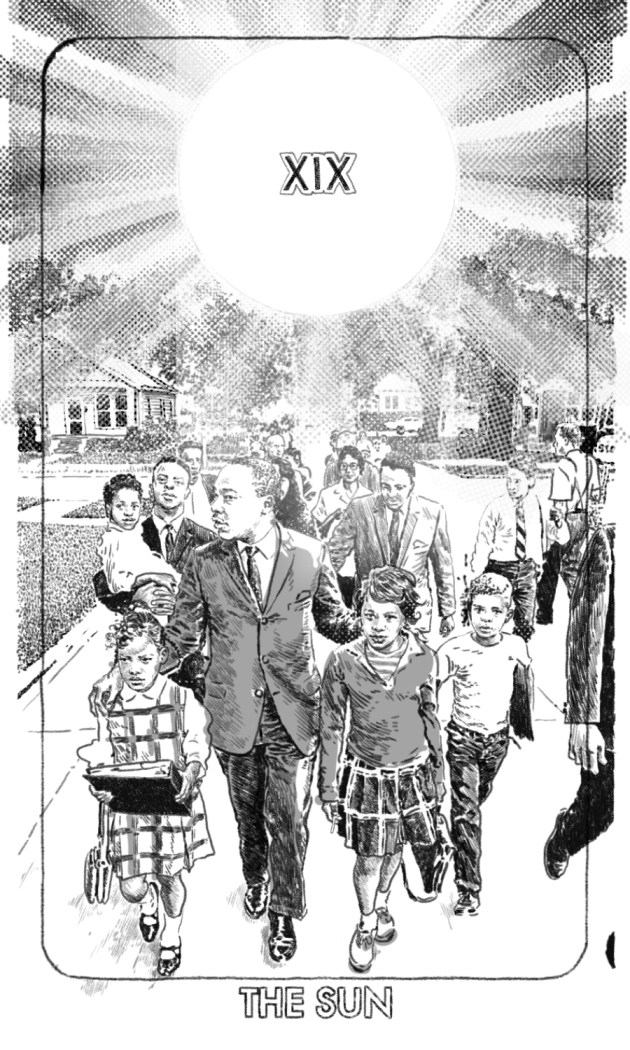
The Sun card is optimistic against the odds. It’s glow passes through the trees, towards the families and clergy-men marching in the streets from a neighboring African American community. They march in dappled light. They march for what they know is justly owed to them. They march for the vote. They march in non-violence. Their march is amongst the most radical of provocations: a peaceful demand for equality in a brutal world.
Starting out with just a few families, some dedicated churchgoers, and placards. But as the days move forward, the sun will watch them be joined by thousands, marching side by side towards a more just tomorrow.
The sun follows these earthly matters and sees those that working towards illumination, and rewards them with the heat they will need to accomplish their goals. The solar warmth reassures and empowers those who feel it’s touch. It reminds us that eventually we can win, because so long as we walk in the sunlight, it will be on our side, time and again, as we push onwards to a brighter future.
AT LENGTH:
Martin Luther King Jr. (Jan 15, 1929 – April 4, 1968) was an African-American Baptist minister, and among the most famed and celebrated civil rights leaders of the 60’s.Inspired by his Christian beliefs and the nonviolent activism of Mahatma Gandhi, he organized pointed nonviolent acts of resistance in defiance of Jim Crow laws and other forms of discrimination. Despite his almost ubiquitous presence within American history and public commemorations including a federal holiday in his name, during his life he attracted animus and ire, with the same strength that he dissolved and denounced hate within his speeches. In 1958 at a book-signing for ‘Stride Towards Freedom’ in Harlem, a mentally-ill elderly black woman stabbed him with a letter opener, and just barely missed the life sustaining aorta which would have certainly killed him. He woke up in the hospital to stacks and stacks of letters from the public wishing and praying for his swift recovery. Federal Bureau of Investigation director J. Edgar Hoover considered King a dangerous radical and made him subject to FBI’s COINTELPRO surveillance and harassment from 1963 until his death. However it was MLK’s adherence to principles of non-violent civil disobedience that put him in conflict with other factions of the civil-rights and emergent black-power movement (such as the Nation of Islam and Malcom X) who saw the state of their struggle to in need of militant self-defense. While he had rejected the communist leanings of some of his collaborators within the Southern Christian Leadership Conference(SCLC) (such as Bayard Rustin), he formed an enduring bond with the socialist wings of the student movement and the civil-rights movement. Towards the end of King’s life he had begun to focus his attention on the Poor Peoples campaign, intending to call forth a ‘multi-racial army of the poor’ to descend upon the nation’s capitol to demand an “economic bill of rights’. KIng’s final book was in many ways a meditation and treatise addressing poverty and social inequity, and the need for protections like jobs-guarantee and universal basic-income. In April 1968 King was assassinated on the balcony of a Memphis hotel room, after delivering his final speech, ‘I Have Been to the Mountaintop’.
Over the decades, MLK’s legacy has been often used as instrument to sanitize the civil rights movement, and re-imagine this struggle as an unthreatening moralism—however this only works if King is indeed like the Sun and one cannot look directly at him. Instead his spirit shines a light on a path towards the horizon of equality, justice, and liberation. His speeches echo through the decades and return to us anew, to remind us to develop a “dangerous kind of unselfishness” , and to protect ourselves and our movement with the enduring power of love.
 monthlysmokeandmirrors.com