“Nature has placed mankind under the governance of two sovereign masters, pain and pleasure. It is for them alone to point out what we ought to do, as well as to determine what we shall do. On the one hand the standard of right and wrong, on the other the chain of causes and effects, are fastened to their throne. They govern us in all we do, in all we say, in all we think.…”
An Introduction to the Principles of Morals and Legislation
-Jeremy Bentham. from, An Introduction to the Principles of Morals and Legislation. 1780
“These are gifts, as anger is a gift. Anger we didn’t ask for: anger which we didn’t begin; anger which is ours regardless. Tragedy is opportunity, devastation is growth, death is renewal.”
-The Otherworlds Review. Contagion Press
KEEP SCROLLING DOWN FOR SHORT & LONG EXPLAINATION
IN SHORT:
UPRIGHT:One or more sudden crisis. Eruptions of tensions. ‘Trial by Fire’. When it rains it pours. Unwanted revelation or conclusions in the process information gathering. Being watched & Surveillance culture.
REVERSED:Period of self-transformation due to circumstances. Having ones fears tested. Escaping the worst of it.’ Call back your energy’. Being seen and quietly held in the minds or hearts of others. New information is waiting.
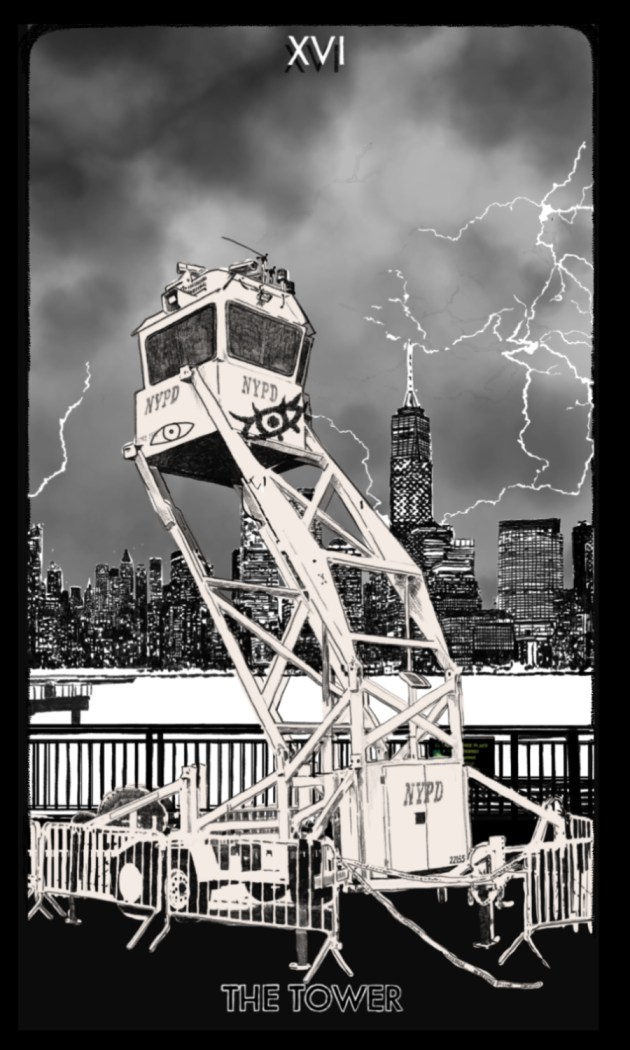
IN DEPTH: The Tower card shows the sky full of veins coursing electricity and a power beyond our control. In the foreground, a police surveillance tower is perched and looking over the waterfront on this dark and stormy night. The tower has been watching and keeping records, but as they watch—they too have been the subject of others watching. Just below the windows of the tower, between the bolts of lightning, two eyes have been graffitied. Because the people are watching as well, and and baring down. Beneath the city’s glimmering lights, the tranquility has been built on a foundation of distrust and domination. The Tower itself may be a solid piece of equipment, but because it is built on social violence, it is a conspicuous target. Itrepresents ambitions and aspirations built on narrow and fearful world-views. It only takes one flash from the sky to illuminates the volatility that has always been just below the surface.
The air is buzzes with tension and emanates visions of catastrophe. This storm might take the electrical grid, the lighting might make the city dark, it might open up a the perfect conditions for a scene of chaos and desires that had been tamped down for far too long. Ominous subtexts, that beckon an inevitable breaking point. The tower assumes total control is a possible and in doing so it invites its opposite. If the Tower card has interrupted your plans, know that, chaos can be just as empowering as control, but it requires a loosening of our grip. If one cannot find humility in turbulent times, the events to come will be humbling to say the least. Crisis has a profound momentum, and it is gathering storm. When lightning strikes, be ready. Because when that bolts cracks the world open you are about to be set free—whether you like it or not.
AT LENGTH:Jeremy Bentham (15 Feb 1748 – 6 June 1832) was an English liberal philosopher, and social reformer. He is generally regarded as the founder of modern utilitarianism. While he held extremely progressive positions for his time(on issues such as gender equality, sexuality, religion, and animal rights) his central axiom “it is the greatest happiness of the greatest number that is the measure of right and wrong”, oriented his work towards carceral discourse and other sinister areas of ‘intellectual work’. His work was critically described by a student of his, John Stuart Mills, as having ” done and to be doing very serious evil.”
His failed plans for an experimental jail—known as the the ‘Panopticon’— became widely influential on contemporary carceral thinking, and served a central object of consideration in Michel Foucault’s Discipline and Punishment. Foucault uses the example of Bentham’s Panopticon prison as a means of representing the transition from the early modern monarchy to the late modern capitalist state. Bentham’s initial concept for the panopticon was essentially one tall prison guard tower, which would be encircled by 360° of jails cells around it, providing the guard a panoramic view of the prisoners. By the effect of backlighting, the guard observes from the tower, becoming ominous silhouette against the light, the captive cells of the periphery left with an infinite feeling of being watched. During Bentham’s life, he spent 26 years theorizing and lobbying towards making this experimental jail a reality, at the age of 63 he came close but ultimately failed. He was also known for his obsession with transparency, his rejection of the notion of ‘inalienable rights’ and having given his body after death to a friend to be turned into an “auto-icon”, something like a human-taxidermy. This Tower card invites you to consider the dangers of what can become of us, when we entertain the notion that everything has a “use”—that everything can be seen, known and controlled.
FURTHER READINGS:
Michel Foucault, ‘Panopticism’ page 196 :
http://architecturalnetworks.research.mcgill.ca/assets/disciplineandpunish-min.pdf
Gilles Deleuze, Postscript on the Societies of Control:
 monthlysmokeandmirrors.com